
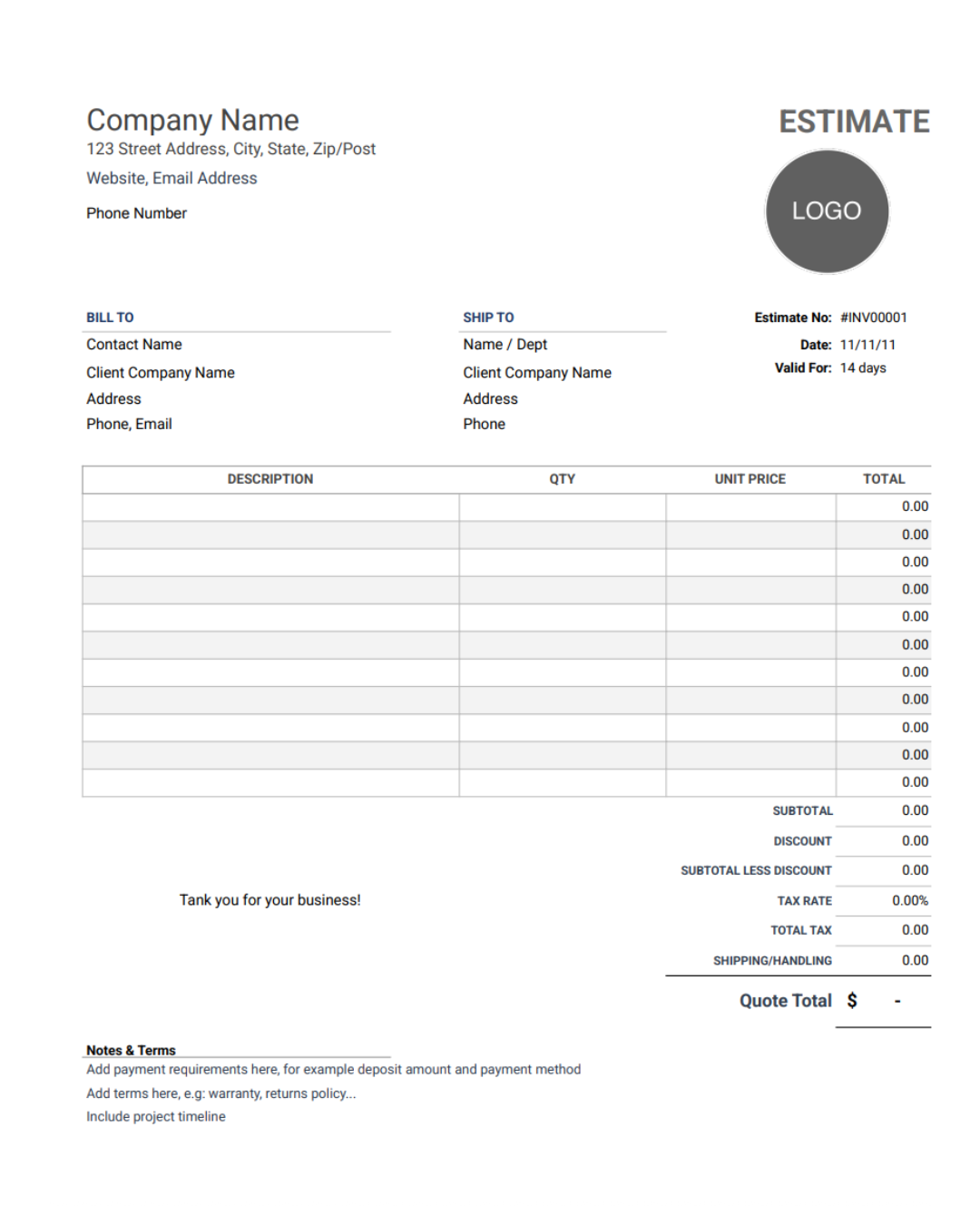
Choose a template below and:
1. Select Download Free Template to save it to your device.
2. Open it in Microsoft Excel, Google Sheets, Apple Numbers, or LibreOffice Calc.
For Google Sheets, upload the file to Drive, then open it with Google Sheets to start editing.
Everyday Excel estimate templates for quoting any project. Totals, discounts, and tax calculate as you type.

A practical estimate for jobs where you want everything sit in one place. Add your billing and shipping details, pricing, discounts, tax, and shipping, plus notes about deposits, timelines, warranties, or other terms.

Use this template when you need to include discounts and shipping in the final estimate. It gives you separate fields for the subtotal, discount, tax, and shipping, along with space for notes about how long the estimate is valid.

A simple estimate with a blue accent and a bit more detail for each line item. Add item numbers, pricing, individual discounts, and any deposit the customer has already paid.
Skip the template. Create, send, and track estimates with Invoicer.
Create Your EstimateExcel estimate templates for service businesses and product sales, with unit pricing and volume discounts.

A straightforward estimate for service jobs. Add the job details, salesperson, payment terms, quantity, and unit price, and the total calculates automatically.

A sales estimate for larger product orders. It includes space for a PO number, tax and credit information, and a built-in volume discount when an order reaches the amount you set.

A simple product estimate with quantity and unit pricing. Add the billing and shipping information, estimate and due dates, and any shipping charges.
Skip the template. Create, send, and track estimates with Invoicer.
Create Your EstimateExcel estimate templates built for specific trades. Enter quantities and rates, and the subtotal, tax, and total calculate automatically.
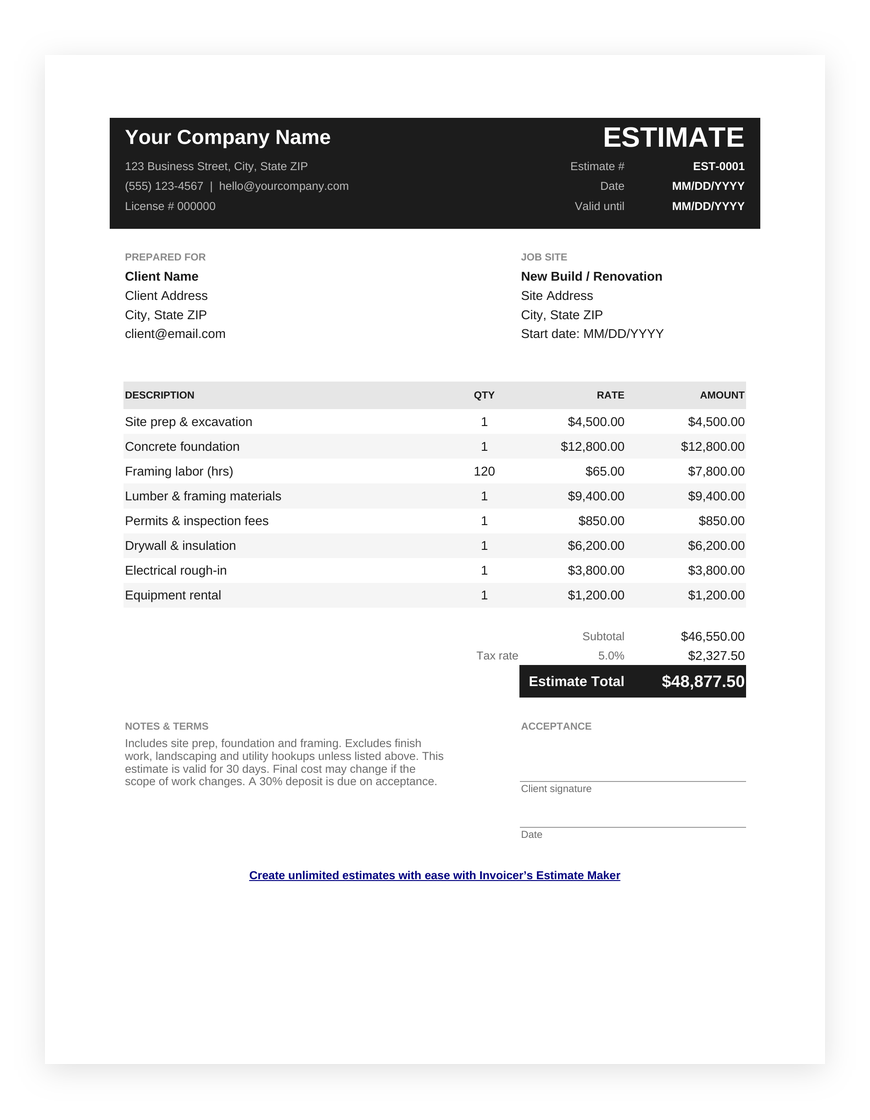
Made for construction projects where you need to break down labor and materials. Add costs for work such as site preparation, foundation, framing, and permits, and the subtotal, tax, and total calculate automatically.
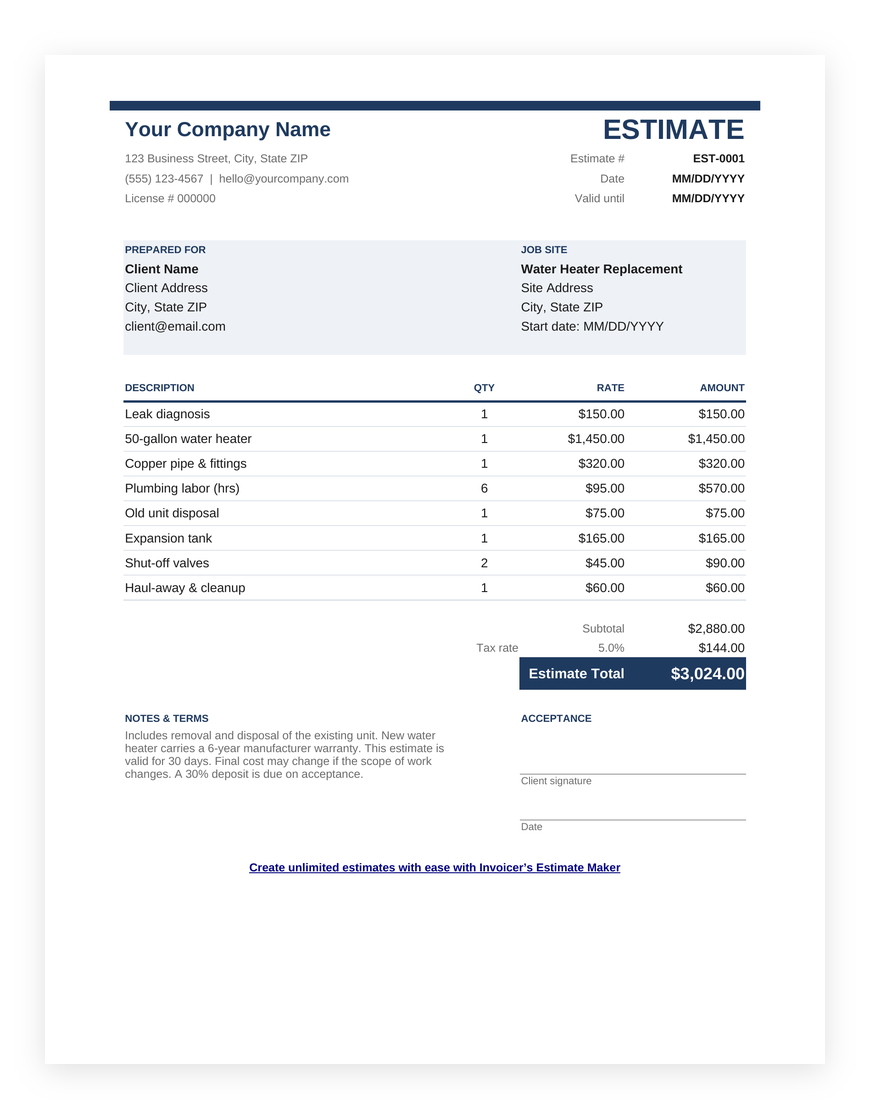
Made for plumbing repairs, installations, and replacements. List parts and labor separately, add the job site details, and let the spreadsheet calculate the total for you.
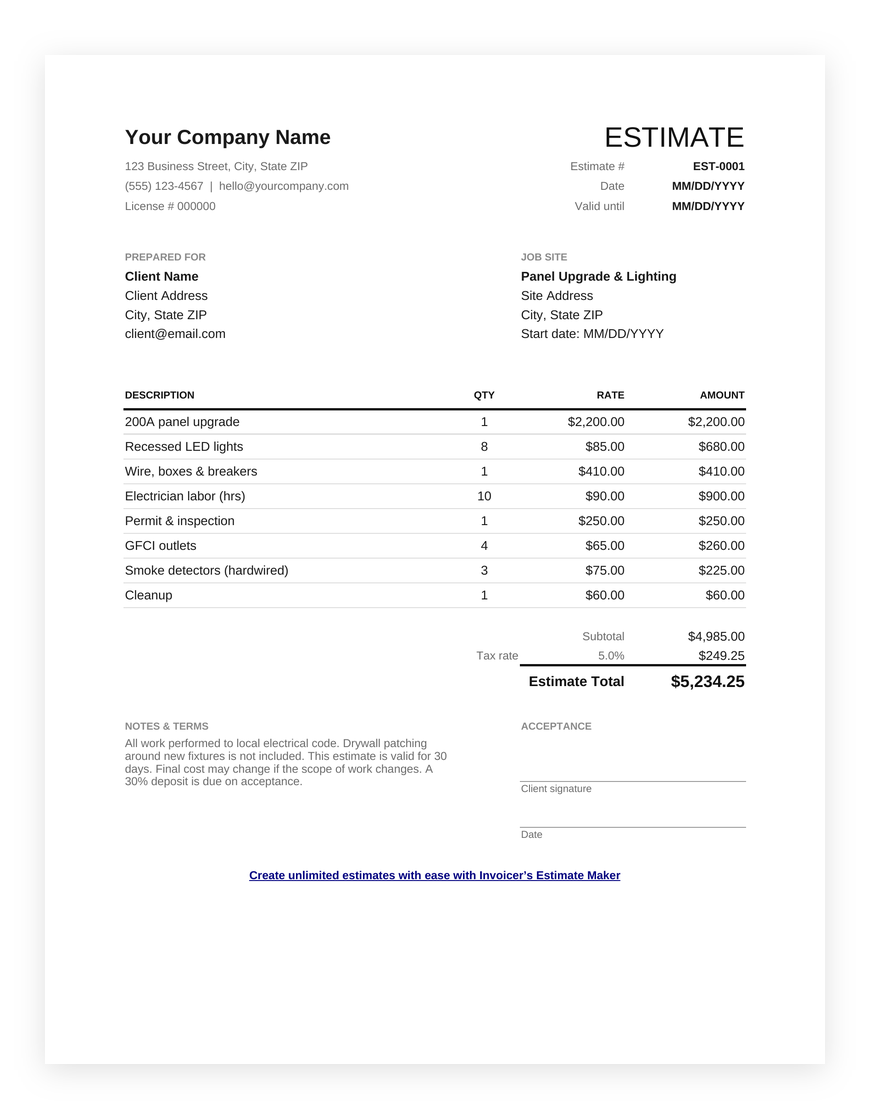
Use this template for electrical jobs such as panel upgrades, lighting, and wiring. Add materials and labor separately, along with notes about permits, project terms, or anything else the customer should know.
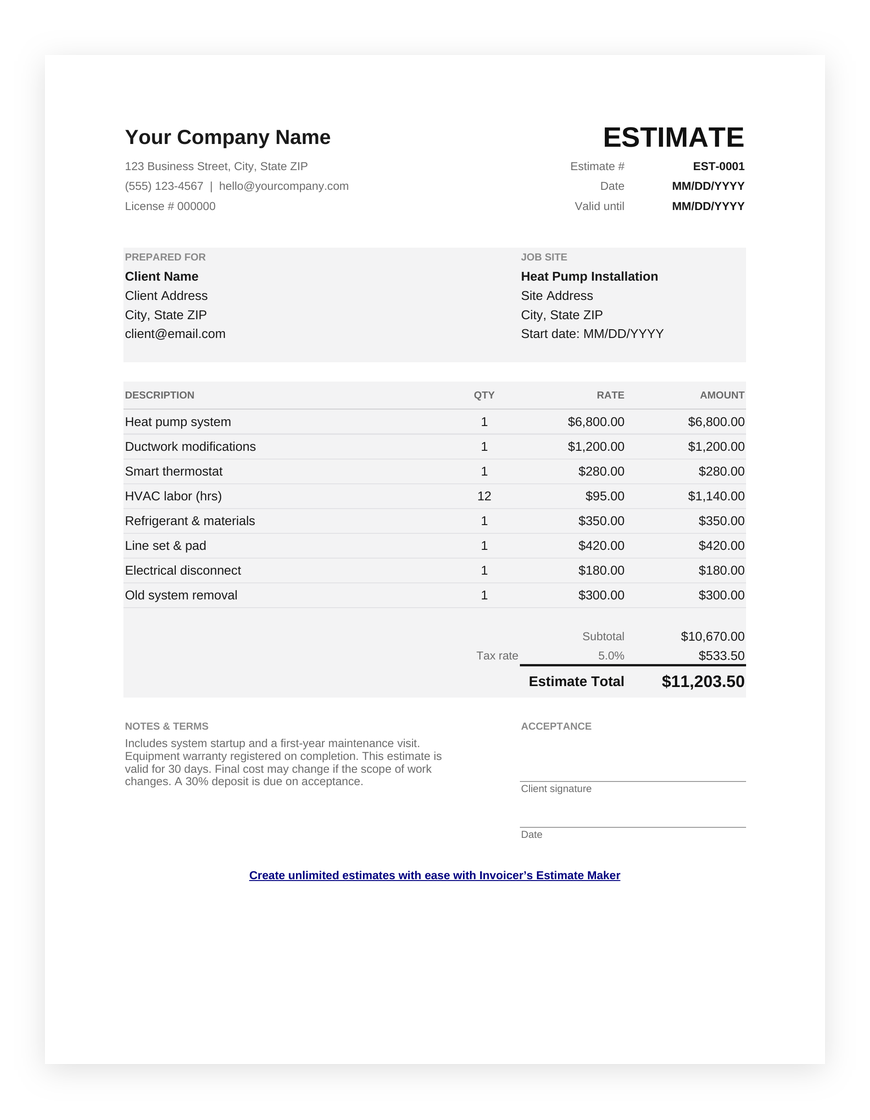
Made for furnace, heat pump, and other HVAC installations or repairs. Equipment and labor are listed separately, and there’s also a signature line for client approval.
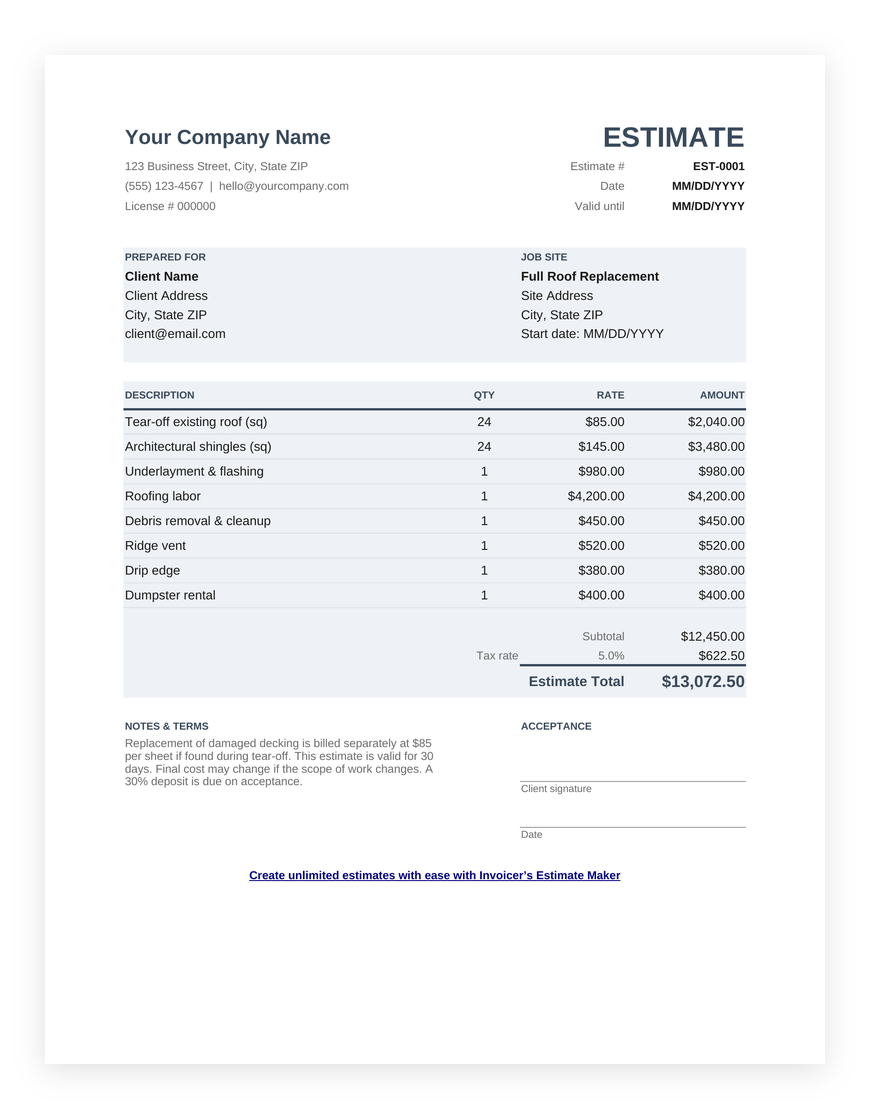
Use this template for roof repairs, replacements, and tear-offs. Price the job by the square, add notes about the scope of work and warranty, and let the totals calculate automatically.
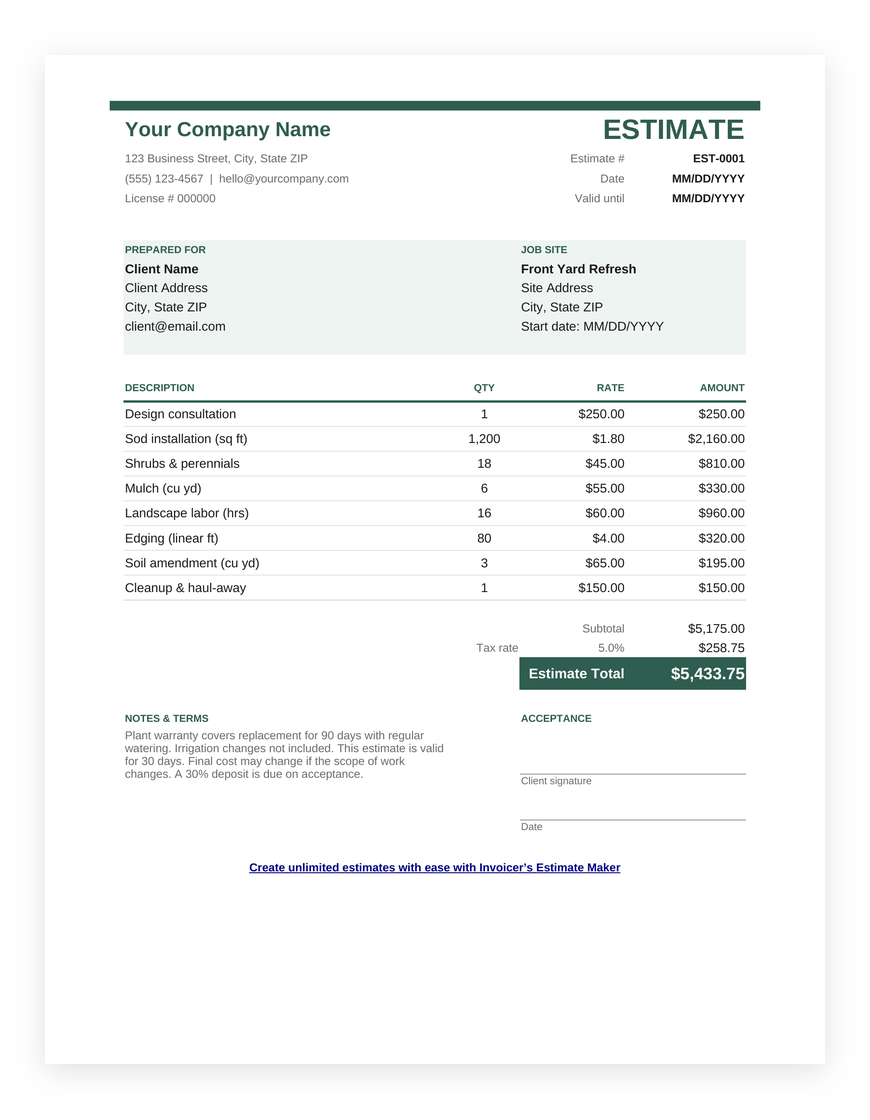
Made for landscaping, planting, sod installation, cleanup, and similar outdoor work. List plants and materials separately from hourly labor, and the spreadsheet calculates the total.
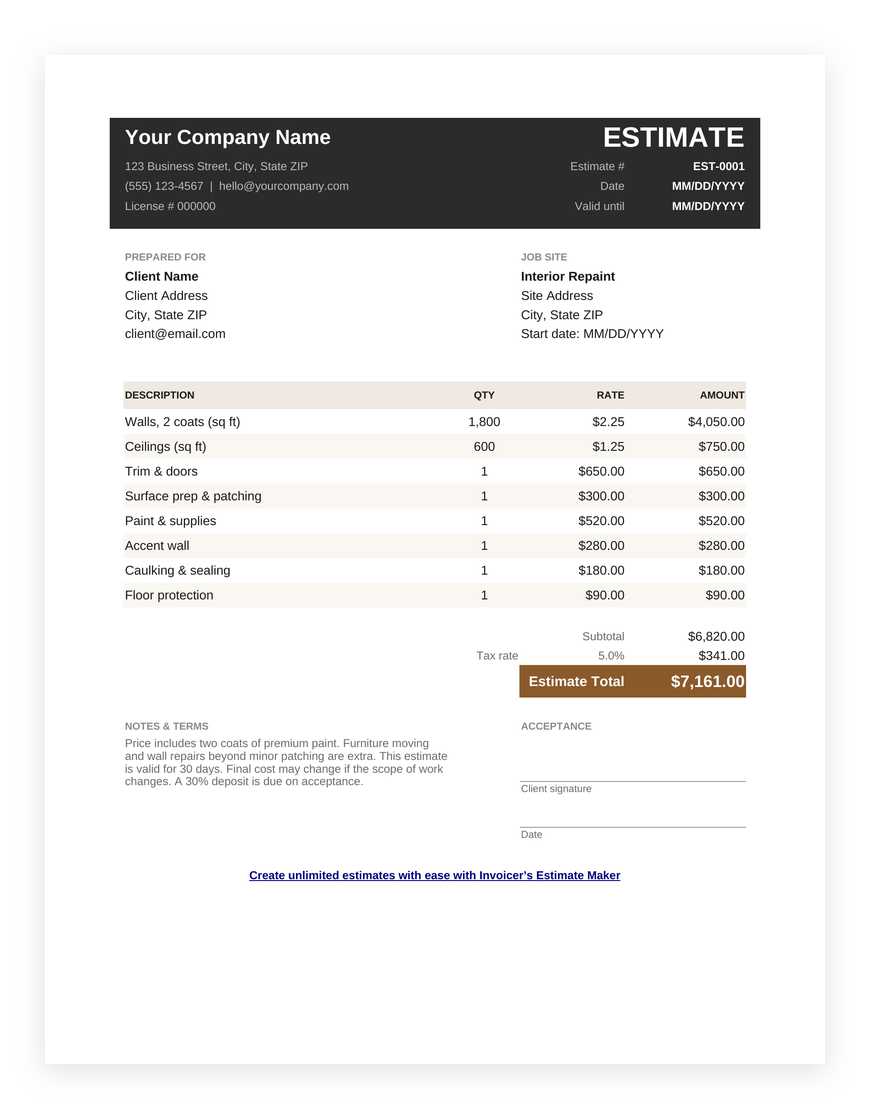
Use this template for painting jobs priced by square footage. Add walls, ceilings, trim, prep work, supplies, and labor separately so the customer can see what the estimate includes.
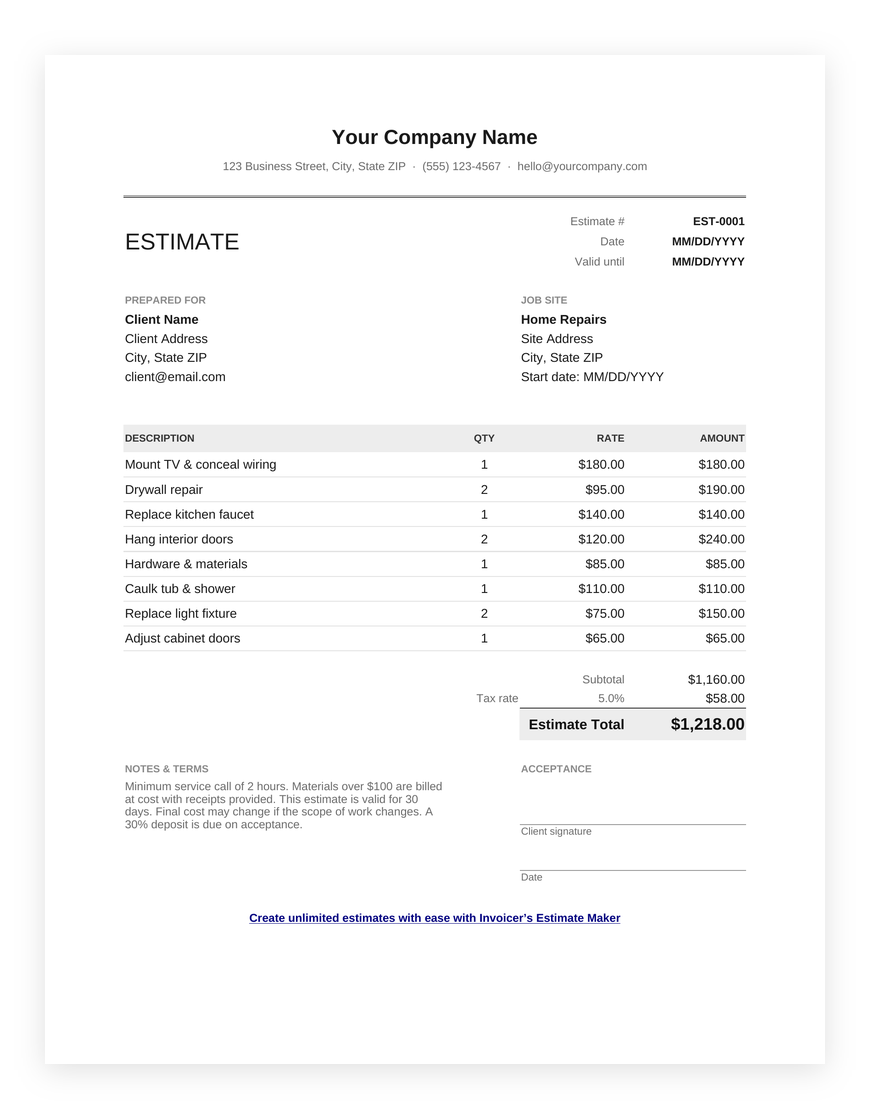
A practical estimate for repairs, maintenance, and smaller jobs. List each task separately, add the pricing, and include a signature line for the client to approve the work.
Skip the template. Create, send, and track estimates with Invoicer.
Create Your EstimateA template gets you a document. An estimate maker gets the job approved and the invoice paid.
| The job | Excel estimate template | Invoicer.ai estimate maker |
|---|---|---|
| Building the estimate | Re-enter line items and prices for every job | Saved items, or describe the job by voice or text and let AI build it |
| Pricing | Dig through old files to remember what you charged | Suggestions based on your past work and local market rates |
| Math | Formulas break the second you insert a row | Totals, tax and markup calculated every time |
| Sending it | Export to PDF, attach to email, hope it opens | Send by email or text, opens on any phone |
| Client approval | Reply somewhere in an email thread | One tap to approve, signed and timestamped |
| Knowing where it stands | No idea if they opened it | See viewed, approved or declined |
| Turning it into an invoice | Copy the numbers into a second file | One click, nothing retyped |
| Getting paid | Chase it separately | Card or bank payment built into the invoice |
| On the job site | Needs a desktop | Works on your phone or tablet |
| Your history | Folders full of files named estimate-final-v3 | Every estimate searchable by client or job |

Easy and intuitive estimate maker.

Clear and simple process for your clients to approve.

Easily customize with your brand and colors.
This guide explains how Excel estimate templates work, who they are best suited for, what to include in them, and how to customize them without affecting the formulas. You’ll also learn when a spreadsheet is enough and when an online Estimate Maker is a better option for sending estimates, collecting approvals, and creating invoices from approved work.
We also offer Excel invoice templates if you need to create an invoice after the work is completed.
Excel estimate templates allow users to enter important details while leveraging formulas for calculations.
Businesses fill in sections such as client information, labor and material costs, taxes, and total estimates. Automated formulas handle calculations, reducing errors and saving time. The estimate can then be saved as a spreadsheet or exported as a PDF.
There are three main ways to set up an Excel estimate template: building a sheet from scratch (time-consuming), using a template (faster and pre-formatted), or using an estimate generator (fastest and most efficient).
An Excel estimate template removes manual calculations, making it ideal for businesses that frequently adjust pricing. If you need a system that calculates taxes, discounts, and totals instantly, Excel is the best option.
Choose the Excel estimate template that best matches the type of work, service, or project you need to quote. Select the download link to open the template, then create a copy of it.
Then, open the copy of the file in Excel and replace the sample information with your business details, customer information, labor rates, materials, taxes, and other estimated costs.
Save the completed estimate under a new file name so you can keep the original template for future use. Before sending it to the customer, review the formulas and totals, check the print layout, and export the estimate as a PDF if you don’t want the recipient to edit the spreadsheet.
Excel estimate templates use built-in formulas to calculate costs as you enter quantities, rates, labor hours, and other pricing details. For example, when you enter a quantity and unit price, the template multiplies them to calculate the line-item total. Labor charges can be calculated by multiplying the number of hours by the hourly rate.
The template then adds the individual line items to calculate the subtotal. Depending on the template, it can also apply discounts, taxes, shipping costs, service fees, or other charges before calculating the final estimated total. When you update a quantity, rate, or tax percentage, the related totals should update automatically.
Enter information only in the designated fields and avoid deleting or replacing cells that contain formulas. If you add new rows, copy the formulas from an existing line-item row so the new amounts are included in the subtotal and final total.
Review every calculation before sending the estimate, especially after changing formulas, inserting rows, or adjusting tax and discount settings.
Add your business name, logo, contact details, payment terms, and branding, then replace the sample customer and project information.
Enter quantities, labor hours, rates, materials, taxes, discounts, and other costs only in the fields intended for manual input. Avoid deleting or typing over cells that calculate line totals, subtotals, taxes, or the final estimate. If you need more line items, copy an existing row so its formulas and formatting are carried into the new row.
After making changes, test the calculations by entering a few sample amounts. Also, check that every new row is included in the subtotal and that taxes and discounts are applied correctly. You can also lock formula cells after customizing the template to reduce accidental changes.
An Excel file doesn’t include a built-in online approval process. You can collect approval by email or signature.
An estimate gives the customer an expected price before the work is approved or completed. It usually includes projected labor, materials, taxes, fees, and other costs, but the final amount can still change if the scope of work changes.
An invoice is sent after the products or services have been provided and requests payment for the amount due.
Learn more about the difference between an invoice, quote, estimate, and receipt.
Pros:
Cons:
This format is best for:
An Excel template may not be the best option if you send estimates frequently, need customers to approve them online, or want to track every estimate without managing separate spreadsheet files. It can also require extra work when several people need to update estimates or access the latest version.
Excel estimate templates are a great starting point. However, for a quicker and more automated solution, the Estimate Maker from Invoicer.ai provides built-in calculations, easy adjustments, professional estimates, and time-saving templates. Plus, you can try it free for 14 days!

