
A late fee is a flat penalty, while interest compounds over time. Here's which is more effective for getting paid.
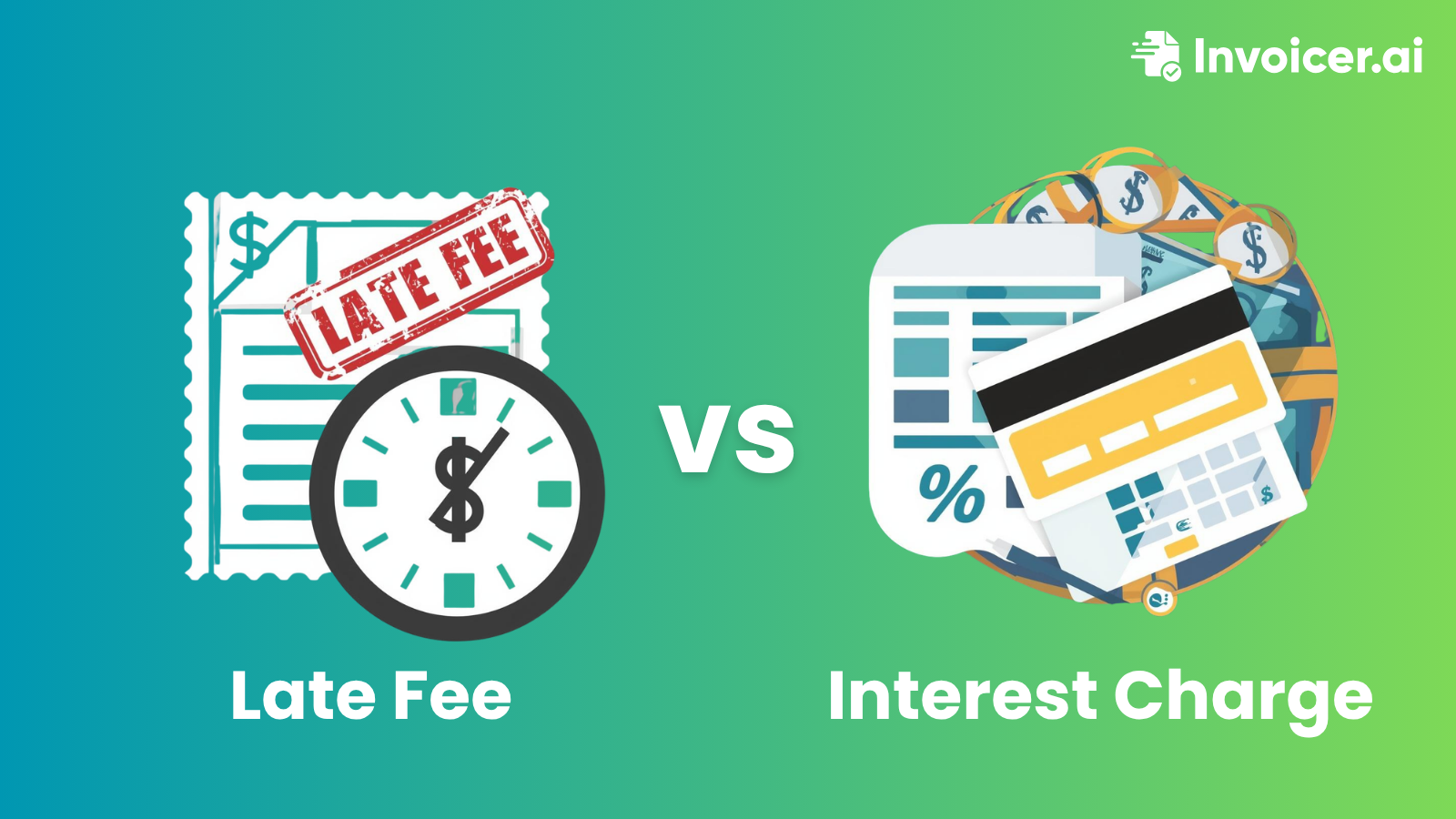
A late fee and an interest charge both penalize overdue invoices, but they work in different ways. That difference matters because it affects how easy the charge is to explain, how clients respond to it, and which option makes more sense for your business.
A late fee is a fixed penalty added once an invoice becomes overdue. For example, you might charge $50 on day 31, no matter how long the invoice stays unpaid. An interest charge works differently. It adds a percentage to the unpaid balance over time, usually each month, until the invoice is paid in full.
Both are meant to encourage faster payment, but they do it in different ways and tend to work better in different situations.
Late fees are straightforward. You set the amount in advance, such as $50 or 5% of the invoice total, and it applies once the due date passes. The client immediately knows what the penalty will be if they pay late. If you are not sure how to choose the right amount, learn how to calculate late fees on invoices.
That simplicity is important. A fixed fee is easy to understand, and clients can quickly see the cost of delaying payment.
Common examples include a flat $25 to $75 fee every 30 days, or a one-time charge of 5% to 10% of the invoice total once the payment becomes overdue.
Interest charges build over time based on the unpaid balance. A common rate is 1.5% to 2% per month, which equals 18% to 24% annually. If you want to estimate the charge on a real invoice, use our Late Payment Interest Calculator.
For example, on a $2,000 invoice, a 1.5% monthly interest charge adds $30 in the first month, then slightly more the next month if the balance remains unpaid.
This can be effective on larger invoices because the cost keeps increasing. Still, it is less immediate and sometimes harder for clients to take seriously at first, especially when the balance is smaller.
For many contractors, freelancers, and small businesses, a flat late fee tends to work better. It feels more immediate because the penalty is specific and easy to grasp.
A client is more likely to react to “you now owe an extra $75” than to a monthly percentage they have to calculate.
Interest charges are often more useful for larger B2B invoices, where the balance is high enough for the growing amount to make a noticeable difference. A $20,000 invoice gaining $300 a month in interest is much harder to ignore.
Yes. Some businesses apply a flat late fee first, then add monthly interest if the invoice remains unpaid for a longer period.
For example:
“A late fee of $75 applies to invoices unpaid after the due date. Invoices still unpaid after 60 days will accrue interest at 1.5% per month on the outstanding balance.”
This approach gives you the immediate push of a fixed fee and the added pressure of interest if payment continues to lag.
For most contractors and freelancers, a flat late fee is usually the better choice. It is easier to explain, easier to apply, and often more effective with everyday clients.
Interest charges make more sense for large invoices or ongoing B2B relationships where the balance is high enough to justify a more detailed payment policy.
Create an invoice with structured payment terms, due dates, and totals. Try Invoicer free for 14 days.
Create your first invoice now
