Invoice Templates for Copywriters
Copywriters help brands tell their story, connect with customers, and turn ideas into words that sell. But behind every polished sentence is a business that needs to stay organized and profitable. A professional invoice is just as important as the final draft.
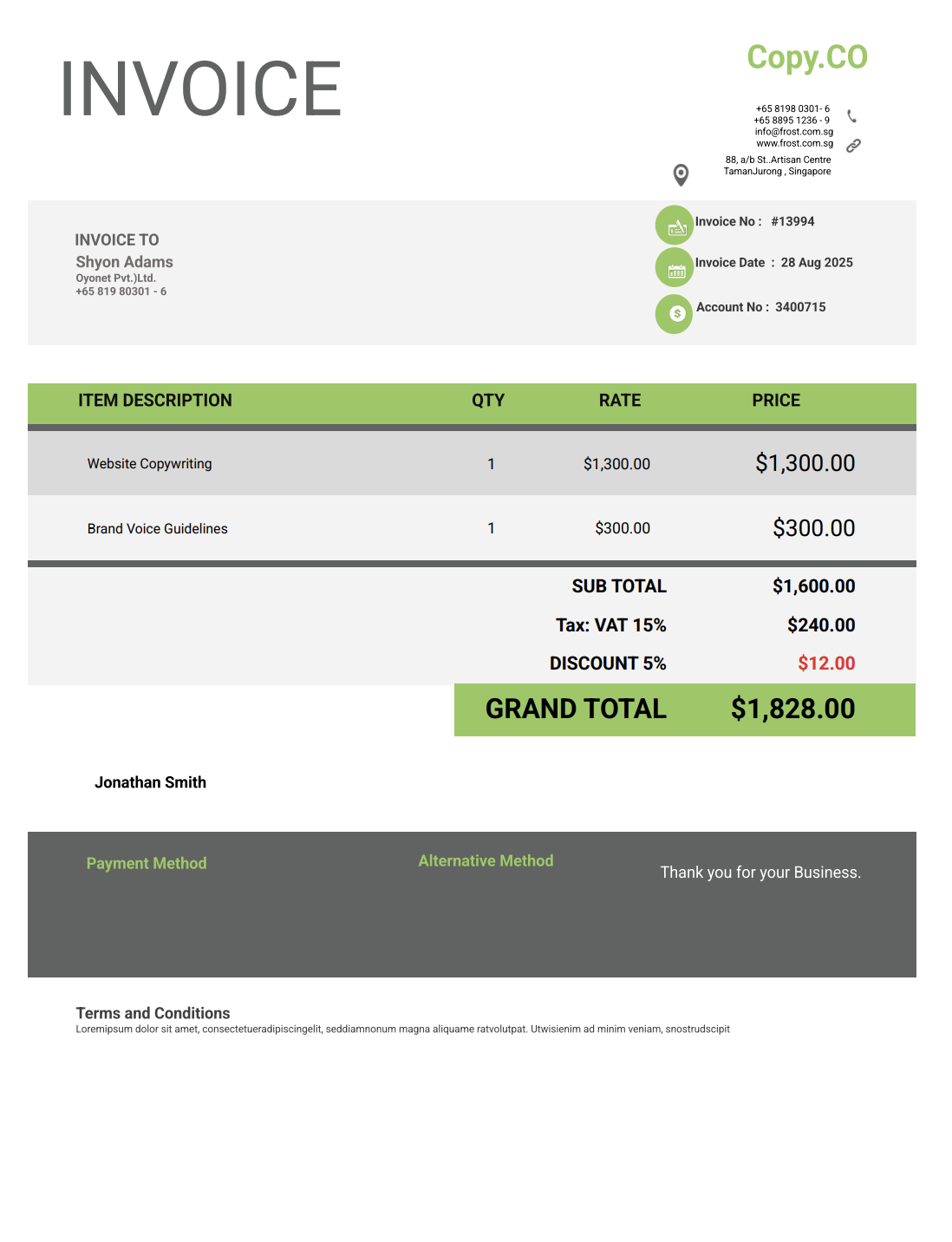
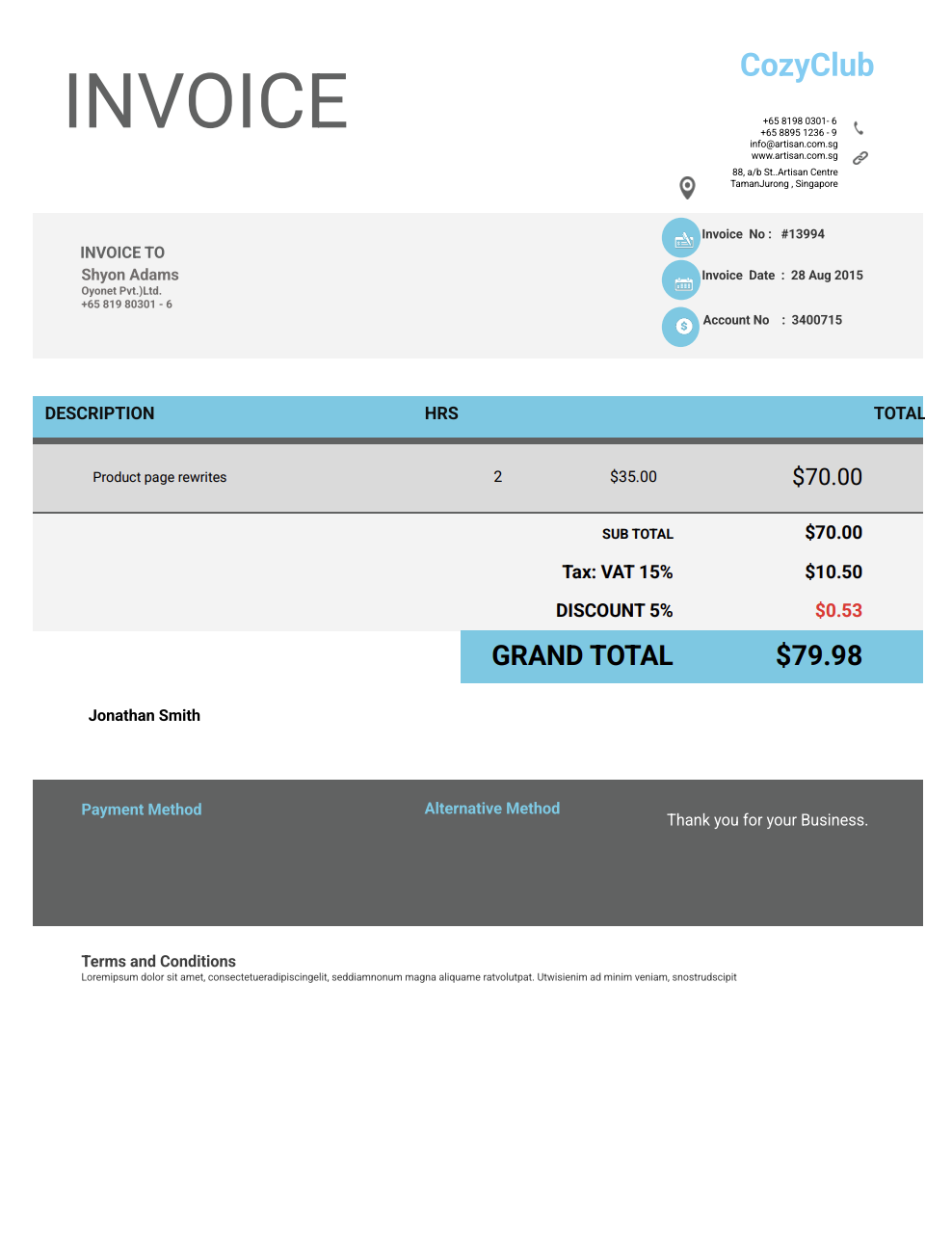
A copywriter invoice template gives you a simple, consistent way to bill for projects, track milestones, and get paid on time. No matter if you charge per hour, per word, or per project, a clear invoice makes it easy for clients to understand what they’re paying for and why.
With Invoicer.ai, you can create copywriter invoices in minutes, either by downloading free Word or Excel invoice templates or by customizing and sending invoices online directly through the software (which is much simpler).
Why Copywriters Need Professional Invoices
Creative work shouldn’t mean financial chaos. Without clear invoicing, payment delays, misunderstandings, and scope disputes can pile up fast. Professional invoices make your writing business as structured as your style guide.
Here’s why they matter:
- Faster payments: Clients pay faster when invoices look official and list clear deliverables.
- Transparency: Each project, revision, and fee is itemized for clarity.
- Proof of work: A detailed invoice shows what was delivered and when.
- Retainer tracking: Perfect for ongoing clients billed monthly.
- Scope protection: Helps prevent unpaid extra edits or project creep.
- Professional image: Clean, branded invoices signal you take your business seriously.
- Tax readiness: Organized billing keeps your freelance income and deductions tidy.
Invoices are your final piece of copy, and the one that gets you paid.
Different Types of Copywriter Invoices
Copywriting projects vary just as much as clients do. Here are the most common types of invoices for copywriters and content professionals:
Per Project Invoice
For one-time jobs like website copy, landing pages, or ad campaigns.
Hourly Invoice
Used for editing, consulting, or small tasks billed by the hour.
Retainer Invoice
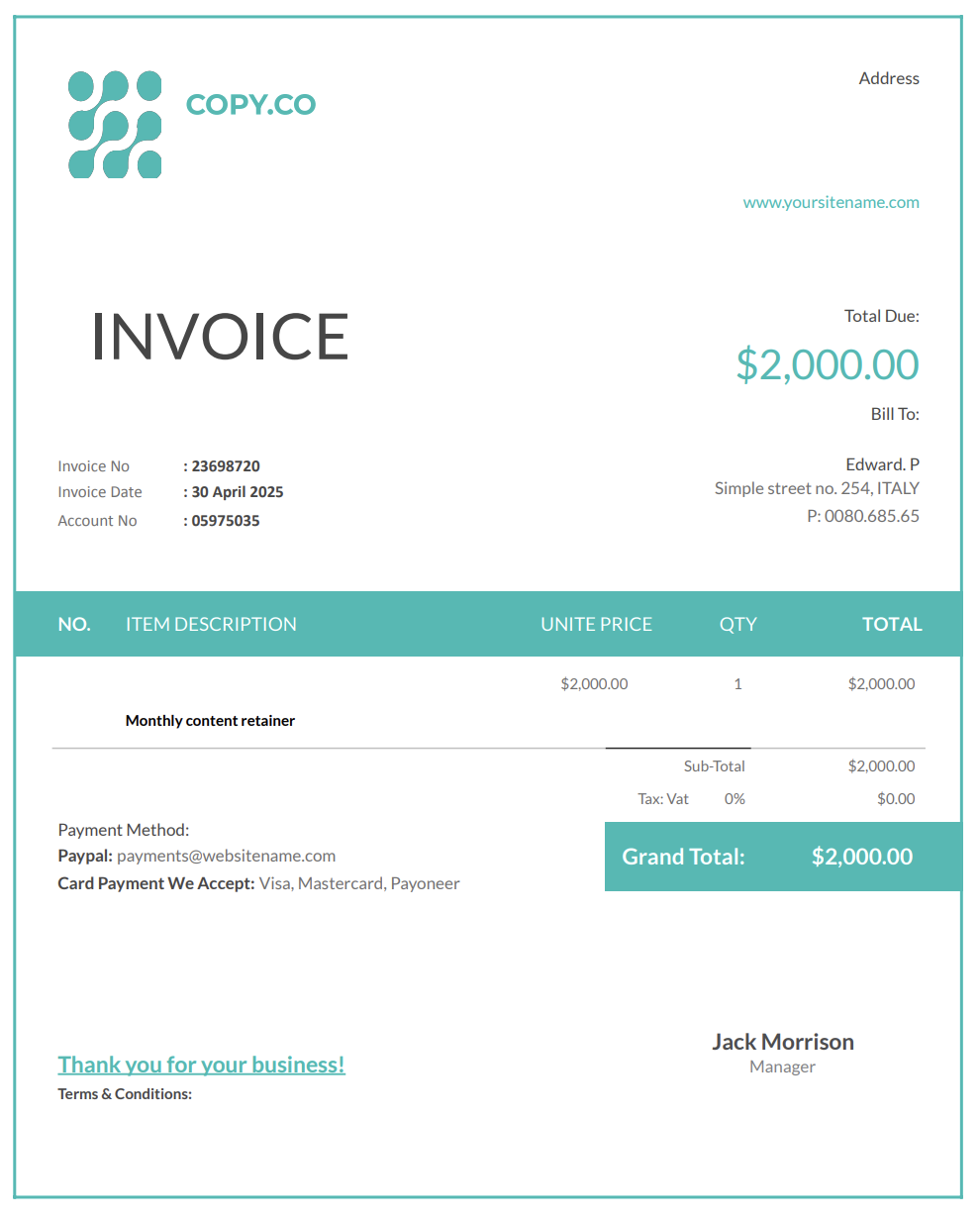
For ongoing content or marketing clients paying a monthly fee.
Per Word Invoice
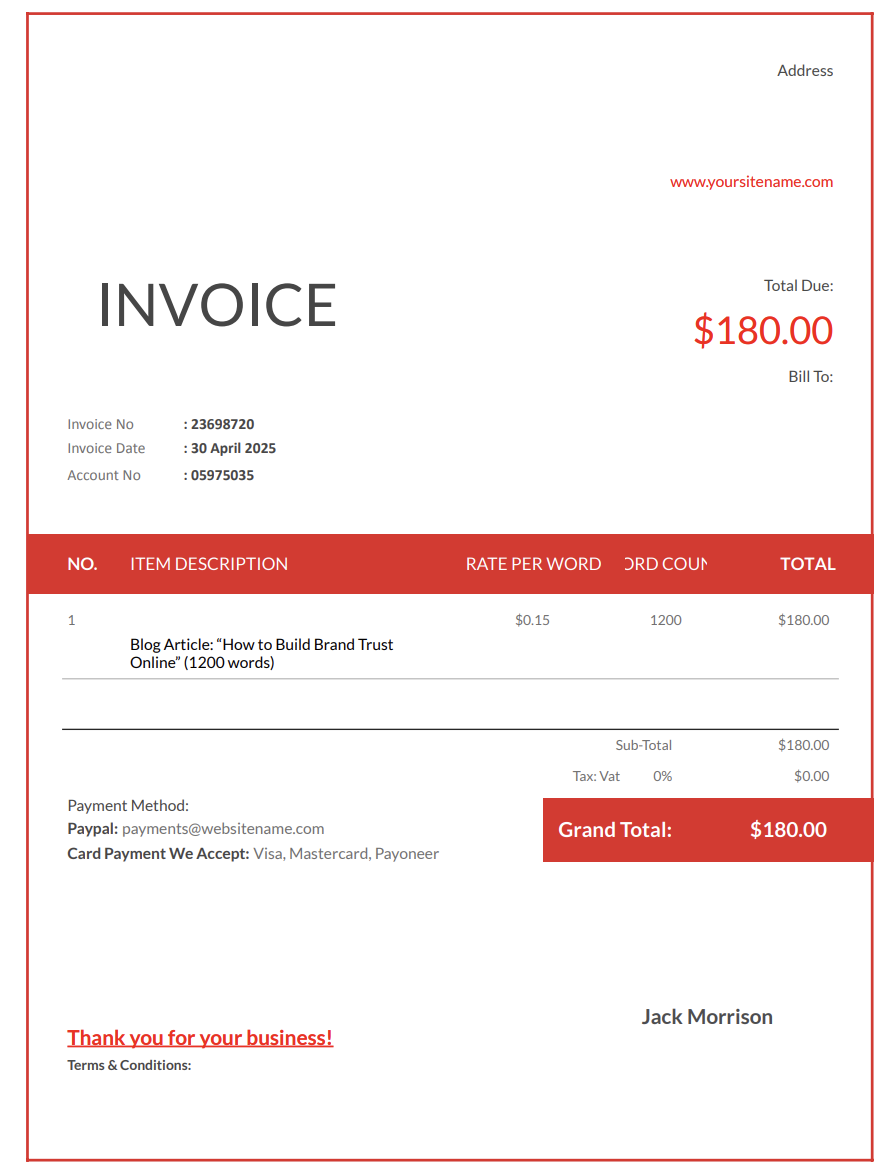
Ideal for article or blog writing priced by word count.
Milestone Invoice
Used for large projects — e.g., 50% deposit upfront, 50% upon delivery.
Rush or Revision Invoice
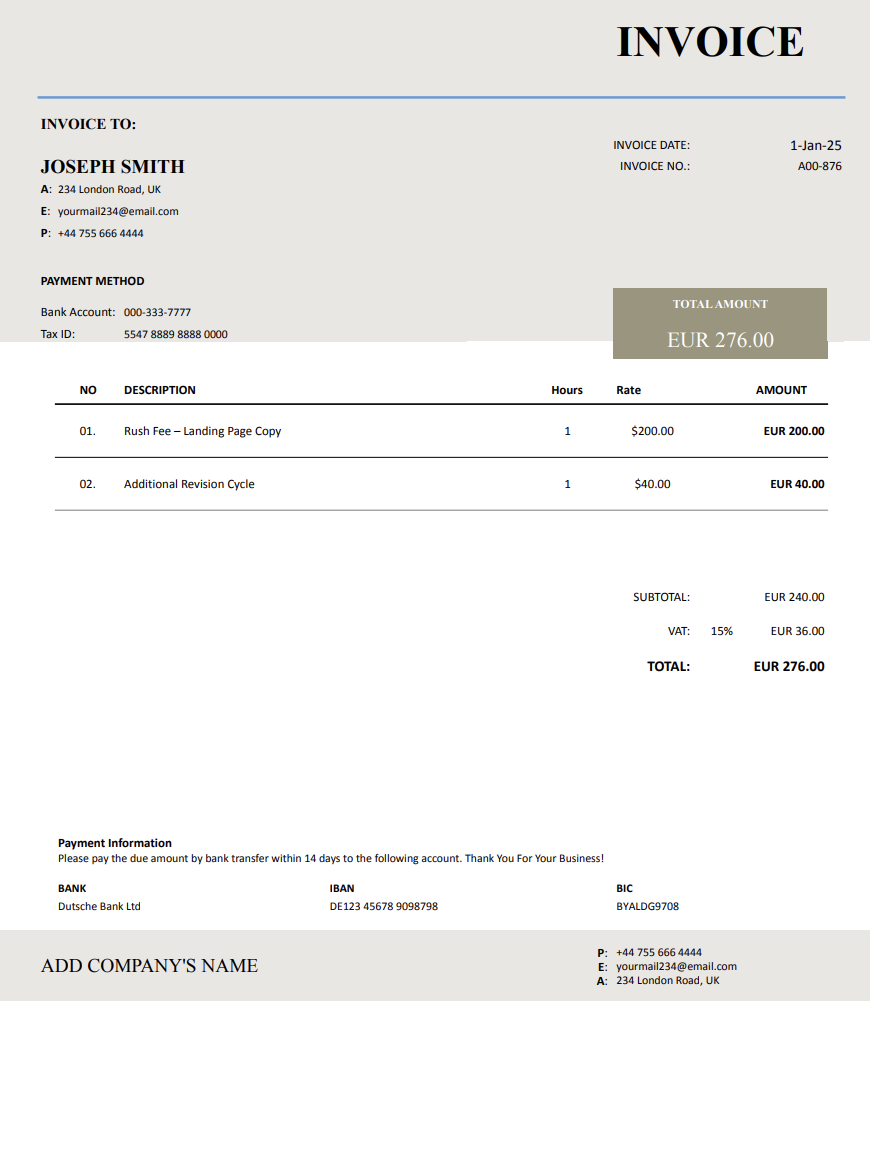
For urgent work or additional edits outside the original agreement.
Retainer Invoices for Ongoing Copywriting
Many copywriters work on monthly retainers for ongoing requests such as emails, website updates, landing page iterations, and content refreshes. A retainer invoice should clarify what is included and how additional work is billed.
Two common retainer structures:
- Flat monthly retainer: a set monthly fee covering an agreed scope or number of deliverables.
- Prepaid hours (drawdown): the client prepays a block of hours, and you deduct time used each billing cycle.
What to include:
- Retainer period (for example, “March 2026 retainer”)
- Included scope (deliverables or hours)
- Overage rate for work beyond the retainer
- If relevant: remaining hours balance after the drawdown
Example line items:
- “Monthly retainer (March 2026) – copy support and optimization”
- “Retainer drawdown: 6.0 hours used (remaining: [X] hours)”
- “Overage work beyond retainer: 1.5 hours @ €___/hour”
What to Include in a Copywriter Invoice
A copywriter’s invoice should be as clear as the content you deliver. Every invoice should include:
- Your information: Name, business name (if applicable), address, email, website, and logo.
- Client information: Company name, contact person, and billing details.
- Invoice number and date: For tracking and bookkeeping.
- Project description: e.g., “Website Copy – 5 Pages” or “Blog Article – 1,200 Words.”
- Itemized costs: Include base fees, revisions, and extras if applicable.
- Payment terms: Due date, accepted methods, and deposit details.
- Taxes/fees: Include where required by law.
- Notes: Mention licensing rights, delivery timelines, or late fees.
Remember, a professional copywriter invoice eliminates confusion. So, the only back-and-forth you’ll do is about great ideas, not overdue payments.
Usage Rights, Ownership, and Where the Copy Will Be Used
Most client work includes the right to use the final copy for the agreed purpose. When copy is being used in paid advertising, repurposed across channels, or licensed for broader use, the invoice should summarize the scope in plain language.
When usage scope matters:
- Paid ads and performance campaigns (high value and broad distribution)
- Licensing copy for multiple brands or territories
- Ghostwriting with byline or attribution considerations
- Repurposing across multiple formats (site + ads + emails + print)
Simple usage examples:
- “Usage: website + organic marketing channels, worldwide, perpetual.”
- “Usage: paid advertising + landing pages for [Campaign], worldwide, 12 months.”
Billing for Research, Discovery, and Interviews
Strong copy often depends on work that happens before the first draft: stakeholder calls, customer interviews, research, and message development. If these are part of your process, they should be billed clearly so clients understand the value.
Common billable pre-writing work
- Discovery call and brief development
- Competitive review and positioning notes
- Customer or stakeholder interviews
- Messaging framework or value proposition draft
- Content outline and structure planning
Example line items
- “Discovery and briefing (60 minutes) + summary”
- “Customer interview (60 minutes) + insights summary”
- “Messaging framework draft (as agreed)”
Revisions, Additional Rounds, and Scope Changes
Copywriting projects often expand through additional feedback cycles, new stakeholder input, or changes to the original brief. A simple revision policy on the invoice keeps expectations aligned and makes extra work billable without friction.
Recommended approach:
- State how many revision rounds are included (for example, 1–2 rounds).
- Define what counts as a revision (edits based on feedback) versus a scope change (new pages, new angle, new audience, new offer).
- Add additional rounds as separate line items once approved.
Suggested invoice note (optional):
“Includes up to [X] revision rounds. Additional revisions or expanded scope are billed separately when requested and approved.”
Example line items:
- “Additional revision round (approved on [Date]).”
- “Scope change: new page added (approved on [Date]).”
- “Rewrite due to brief change after draft delivery (approved on [Date]).”
Example Line Items for Copywriter Invoices
Professional, specific line items help clients approve invoices faster and reduce follow-up questions. Use the examples below and adjust the scope, word counts, and deliverables to match your project.
Website and landing page copy:
- “Homepage copywriting (approx. [X] words) for [Brand], includes 1 revision round.”
- “Landing page copy for [Campaign/Product] (1 page), includes CTA variants (3).”
- “About page copywriting (approx. [X] words) + brand positioning alignment.”
Email and lifecycle:
- “Email sequence: [X] emails for [Campaign], includes subject line options (3 per email).”
- “Newsletter copywriting: [Month/Issue] (1 send).”
- “Welcome flow optimization: rewrite + CTA improvements (as agreed).”
Content and editorial:
- “Blog article: ‘[Title]’ (approx. [X] words), SEO brief included.”
- “Case study draft (1,200–1,500 words) based on client interview.”
- “Editing and rewrite of existing draft (approx. [X] words).”
Strategy and research:
- “Messaging framework workshop + summary (as agreed).”
- “Competitive review + positioning notes (as agreed).”
- “Customer interview (60 minutes) + insights summary."
Tips to Get Paid Quickly as a Copywriter
Freelance writers often wait weeks (or months) for payment. These strategies help you keep cash flow consistent:
- Bill quickly: Send the invoice as soon as you deliver your work.
- Use deposits: Request 30–50% upfront to secure your time.
- Offer flexible options: Accept cards, transfers, or online payments.
- State payment terms upfront: Include them in both your contract and invoice.
- Send reminders: Automate polite follow-ups through Invoicer.ai.
- Keep records organized: Track invoices, revisions, and deadlines in one place.
- Offer receipts: Clients appreciate confirmation for their finance teams.
Rush Fees and Expedited Delivery
Copywriting often supports launches and campaigns with fixed deadlines. If you deliver on an expedited timeline, it is reasonable to invoice a rush fee.
How to bill rush work:
- Make it a separate line item (“Rush fee” or “Expedited delivery”).
- Reference the turnaround time (for example, “24–48 hour delivery”).
- Apply it consistently so clients understand the policy.
Example line items:
- “Rush fee (24–48 hour turnaround).”
- “Same-day revisions (as agreed).”
When and How to Send Copywriter Invoices
Your invoicing schedule should fit your workflow and client type:
- Per project: Invoice upon delivery or split into deposit + final payment.
- Retainer clients: Bill monthly on the same date for consistency.
- Hourly work: Invoice weekly or bi-weekly with tracked time entries.
- Milestone projects: Invoice after each agreed stage is completed.
- Agency clients: Follow their billing cycles but use your own branded invoice.
- Revisions or extras: Send separate invoices for work beyond the initial scope.
With Invoicer.ai, you can send invoices instantly, track when clients open them, and automate late-payment reminders.
Simple Tweaks to Make Your Copywriter Invoice Stand Out
Copywriter invoices don’t need clever taglines. They just need structure, clarity, and a touch of your personal brand.
- Add your logo and tagline: It reminds clients of your professional identity.
- Keep layout minimal: Clean lines and white space make it readable.
- Highlight payment details: Make due dates and bank info easy to find.
- Reference project titles: Example: “Invoice for Blog Series – March 2025.”
- Include version control: Note which draft or deliverable the invoice covers.
- Show gratitude: A short thank-you note like “Appreciate the collaboration!” adds warmth.
- Add online payment links: One click and you’re paid.
Why Choose Invoicer.ai Over Word, Excel, or QuickBooks
Most copywriters start with Word or Excel invoices until formatting breaks and totals don’t add up. QuickBooks might work for accountants, but it’s too heavy for freelancers who just want clean, efficient billing.
Invoicer.ai offers the best of both worlds:
- Pre-built copywriter invoice templates (Word, Excel, PDF).
- Create and send invoices online in minutes.
- Save templates for regular clients.
- Add per-word, per-hour, or flat-rate pricing easily.
- Send invoices with payment tracking.
- Automatic reminders for overdue balances.
- Clean, modern layouts that match your brand style.
- Recurring invoices. Availible on Advanced plan.
It’s the easiest way to make sure your words actually pay the bills.
Get Paid the Easy Way
A copywriter invoice template helps you stay organized, professional, and paid on time. Instead of chasing clients or retyping old invoices, you’ll have a smooth system that supports your creativity and business growth.
Once the invoice is ready, you can schedule it to send when it makes the most sense for the job or your billing routine.
Start your free 14-day trial today and let Invoicer.ai handle the billing for you!