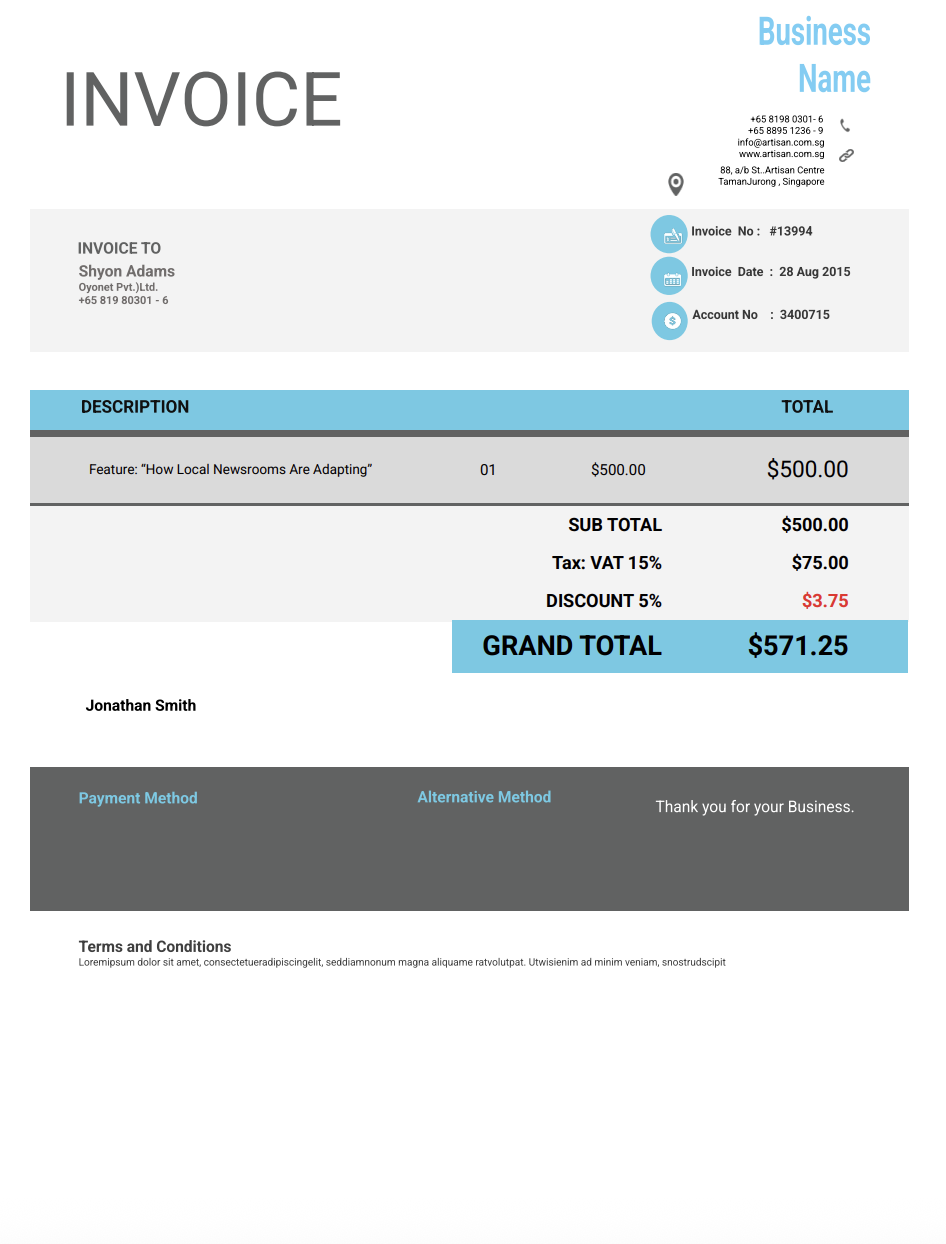
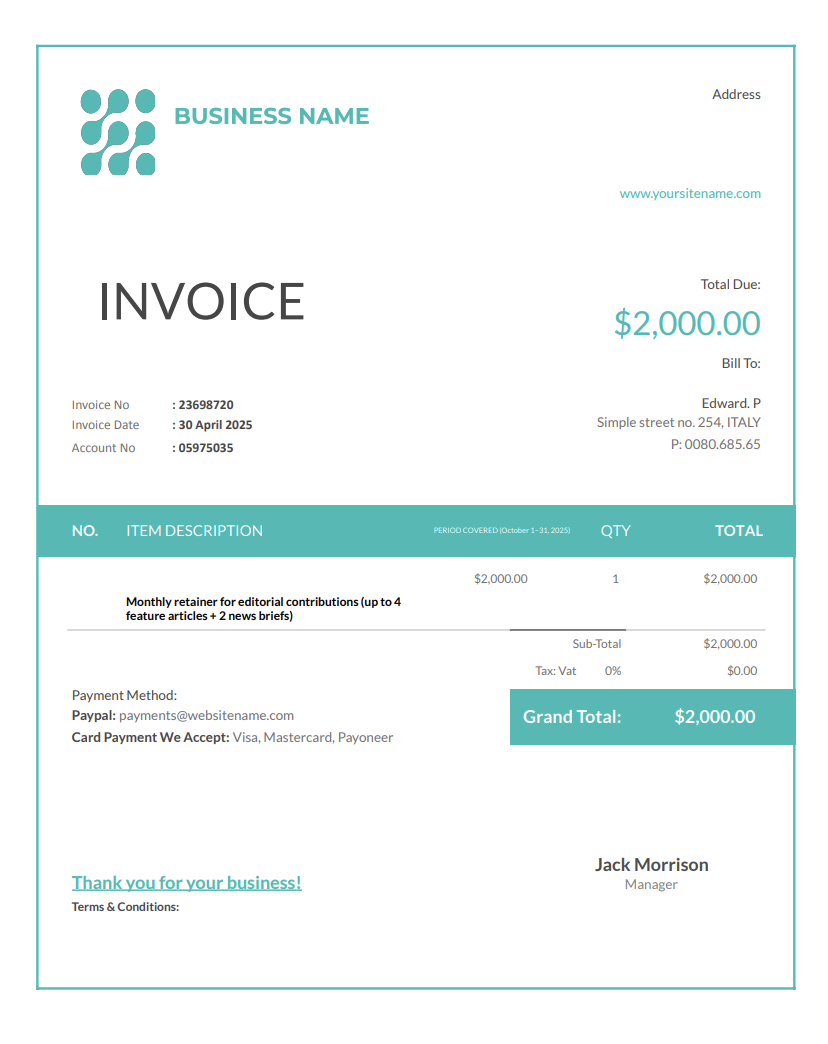
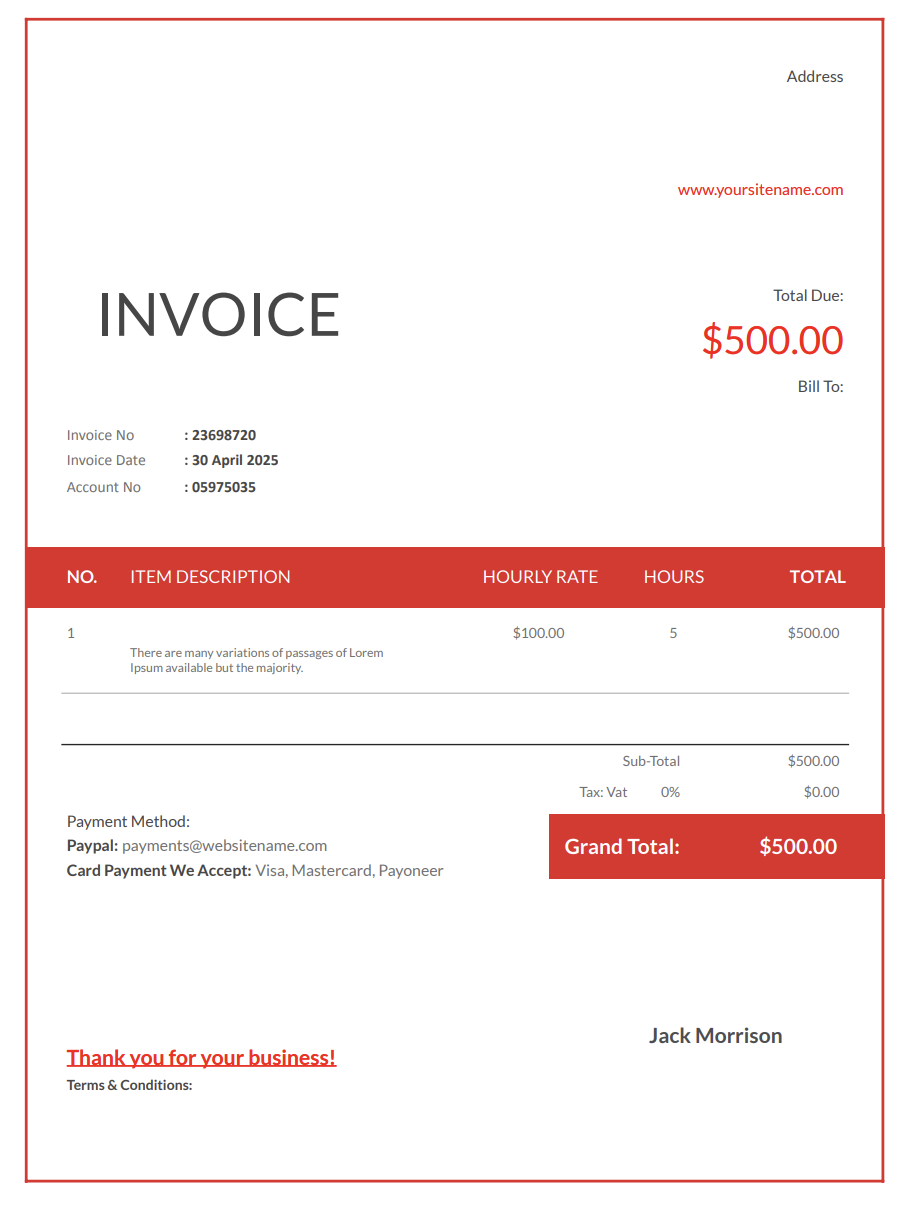
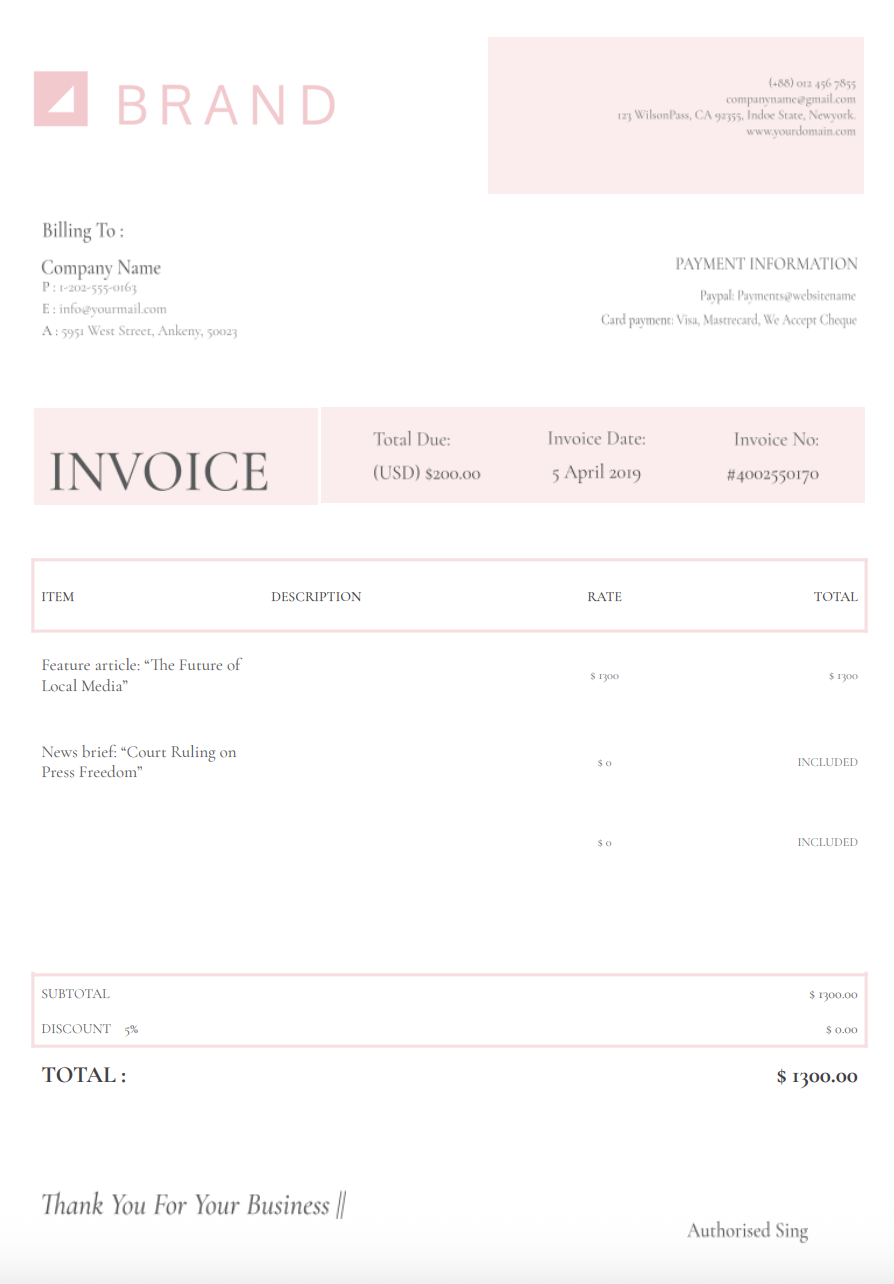
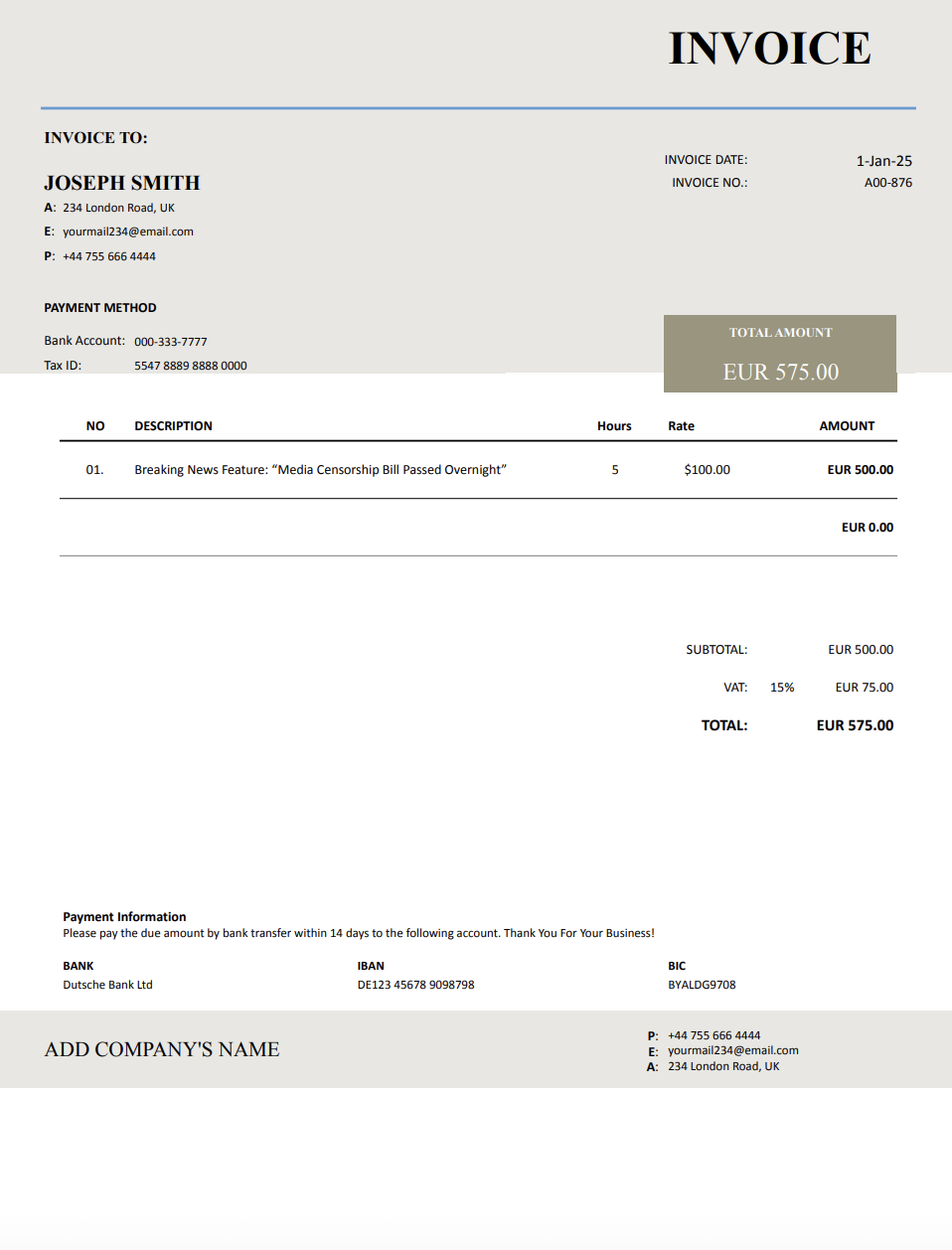
Invoice Templates for Freelance Journalists
Freelance journalists dedicate their work to uncovering stories, providing insights, and giving a voice to people and events that matter.
No matter if you write for newspapers, magazines, online platforms, or corporate publications, your reporting is the product of hours of research, interviews, and writing.
However, journalism is not only about telling stories. It’s also about running a business. Without proper invoicing, payment delays and misunderstandings can leave you struggling to balance creativity with financial stability. A professional invoice is just as important as your byline.
With Invoicer.ai, you can create journalist invoices in minutes, either by downloading free Word or Excel invoice templates or by customizing and sending invoices online directly through the software (which is much simpler). Once the invoice is ready, you can schedule it to send when it makes the most sense for the job or your billing routine.
Why Freelance Journalists Need Professional Invoices
The freelance media world is fast-paced and competitive. Editors and accounting departments handle dozens, sometimes hundreds, of contributors. Without a proper invoice, your work can easily get overlooked in the system.
Here’s why invoices are essential for journalists:
- Quick payments: Formal invoices speed up processing by finance teams.
- Clarity for editors: Itemized charges make it clear what is being billed.
- Protection of work: Invoices serve as a record of what was delivered and when.
- Expense tracking: Travel, lodging, or research costs can be billed transparently.
- Professional credibility: Structured invoices show you take your craft seriously.
- Tax readiness: Organized invoices make accounting and reporting easier.
- Repeat business: Editors are more likely to rehire freelancers who handle admin smoothly.
Different Types of Freelance Journalist Invoices
Journalism assignments vary, and your invoices should match the type of work. Common formats include:
Per-Word Invoice
For publications that pay by the word.
Per-Article Invoice
Used when billing for individual articles, features, or op-eds.
Retainer Invoice
For ongoing arrangements where you provide a set number of articles per month.
Research and Interview Invoice
Itemizes hours or days spent gathering information.
Travel Invoice
Includes expenses for assignments requiring trips, lodging, or meals.
Rush Fee Invoice
Used when expedited work or tight deadlines warrant an additional charge.
What to Include in a Freelance Journalist Invoice
A journalist’s invoice should be professional, clear, and tailored to editorial workflows. Be sure to include:
- Your information: Full name, business name (if applicable), address, phone, and email.
- Client information: Publication name, editor’s name, and billing department contacts.
- Invoice number and date: For easy reference and tracking.
- Service description: For example, “Feature article: 1,200 words on renewable energy trends” or “Interview and profile of local artist.”
- Itemized costs: Word count rates, flat article fees, research, and travel expenses.
- Payment terms: Due date, accepted methods, and late fees if applicable.
- Retainer or contract reference: Indicate if it’s part of an ongoing agreement.
- Taxes/fees: Include if required in your jurisdiction.
- Notes: Submission dates, issue references, or special terms agreed upon.
Example Line Items for Freelance Journalist Invoices
A clear description line reduces follow-up questions from editors and accounting teams. Use the examples below and adjust the details to match your assignment.
Per-word / per-article work:
- “Feature article: ‘[Title]’ (1,200 words) at €[rate]/word. Submitted: [Date].”
- “Reported article (flat fee): ‘[Title]’ for [Publication]. Submitted: [Date].”
- “Op-ed (flat fee): ‘[Title]’ for [Publication]. Accepted: [Date].”
Research and interviews:
- “Research and reporting (6 hours) for ‘[Project/Topic]’.”
- “Interviews: [Name/Role] + [Name/Role] (2 interviews, scheduling + prep included).”
- “Transcript review and fact-check support (2 hours) for ‘[Title]’.”
Multimedia and deliverables:
- “Original photography (10 edited selects) for ‘[Title]’.”
- “Audio recording and cleanup for interview (1 file delivered).”
- “Captions, alt text, and metadata provided for published assets.”
Expenses (kept separate):
- “Travel: [Route] on [Date] (public transit/parking/tolls).”
- “Accommodation (1 night) for assignment on [Date].”
- “Records request/access fee (receipt attached).”
Tips to Get Paid Quickly as a Freelance Journalist
Many freelancers face long waits for payments. These strategies help improve turnaround:
Invoice Immediately
Send invoices when the article is filed, not weeks later.
Reference Editor Agreements
Include assignment numbers or issue dates.
Ask About Payment Cycles
Some outlets pay monthly or quarterly—plan accordingly.
Offer Flexible Payment Options
Bank transfers, PayPal, or direct deposit.
Track Deadlines and Payments
Keep a log to follow up if payments are late.
Send Polite Reminders
Professional follow-ups reduce overdue balances.
Include Expenses Upfront
Don’t wait until months later to add travel or research costs.
Publication Onboarding Details That Prevent Payment Delays
Many late payments are not caused by editors. They happen because the publication’s finance team is missing basic vendor information. Including (or proactively providing) the details below can prevent your invoice from being rejected or stuck in “pending” status.
Information finance teams often require:
- Legal name and billing address (exactly as you want it on remittance)
- Preferred payment method (bank transfer details or other method you accept)
- Tax or registration identifiers (only if applicable in your jurisdiction)
- A purchase order (PO) number or assignment ID (if the outlet uses them)
- The correct billing email or portal submission instructions
Practical tip: If a client repeatedly delays payment, ask whether they have a vendor onboarding checklist. It’s faster to provide the required fields once than to re-issue invoices every month.
Simple Tweaks to Make Your Freelance Journalist Invoice Stand Out
Invoices don’t need to be elaborate, but thoughtful touches help them get processed faster:
- Add branding: Use your name, logo, or portfolio site link.
- Highlight article details: Title, issue, and editor name for clarity.
- Show word counts: Essential if you’re billing per-word rates.
- Include expenses separately: Keep travel and article fees distinct.
- Emphasize payment terms: Bold the due date and total amount.
- Provide payment links: Editors and publishers appreciate simplicity.
Remember, a clean, professional invoice signals you are reliable, organized, and easy to work with.
Revisions, Additional Rounds, and Extra Deliverables
Most assignments include reasonable edits, but extended revision cycles and new deliverables can quietly expand the scope. When additional work is requested beyond the original agreement, it should be reflected clearly as a separate line item.
Common scope additions journalists can invoice for (when agreed):
- Additional revision rounds beyond the agreed number
- Significant rewrites due to a changed angle after reporting is complete
- Additional interviews are requested after the draft is submitted
- New deliverables (second version for a different platform, extended Q&A, companion piece)
- Rush turnaround on edits or rewrites
Optional invoice note: “Additional revisions or expanded deliverables may be billed separately when requested and approved.”
When and How to Send Freelance Journalist Invoices
Timing matters in journalism invoicing. Here are common practices:
- Per-article: Invoice once the piece is submitted (or accepted, if required).
- Retainers: Send invoices monthly, referencing the scope of work.
- Expenses: Include them with the main invoice or submit separately if required.
- Rush fees: Invoice alongside the main article with a line item for urgency.
- International work: Invoice immediately to allow for extended processing times.
With Invoicer.ai, you can send invoices instantly, track when editors open them, and receive automated reminders for late payments.
Kill Fees, Cancellations, and Assignments That Don’t Run
Freelance journalism often includes situations where work is commissioned but not published due to editorial changes, scheduling shifts, or a story being pulled. If a kill fee (or cancellation fee) applies, your invoice should document the scope completed and the agreed payment basis.
What to include when invoicing a kill fee:
- Assignment title or ID and the agreed rate
- What was completed (research, interviews conducted, draft submitted)
- The date the assignment was canceled or pulled
- The agreed kill-fee percentage or amount (if previously agreed)
Example line item: “Kill fee for ‘[Title/Topic]’ (research + interviews completed; draft in progress) per assignment agreement.”
Why Choose Invoicer.ai Over Word, Excel, or QuickBooks
Many journalists begin with Word or Excel invoices. While simple, they can become disorganized quickly, especially if you’re juggling multiple publications. QuickBooks is robust but often unnecessary and costly for freelancers.
Invoicer.ai bridges the gap by offering:
- Pre-built journalist invoice templates (Word, Excel, PDF).
- Quick online invoice creation—no spreadsheets needed.
- Save templates for regular clients or recurring arrangements.
- Add expense and per-word fields easily.
- Email invoices with payment tracking.
- Automated reminders for overdue balances.
- Clean, professional formatting publishers appreciate.
- Recurring invoices. Availible on Advanced plan.
It’s designed to free up your time so you can focus on reporting—not paperwork.
Get Paid the Easy Way
Spend less time chasing payments and more time writing stories that matter. Try Invoicer.ai free for 14 days now.