Invoice Templates for Video Editors
Every edit tells a story, but behind the color grades and perfect transitions is a business that runs on structure and trust. Whether you cut wedding reels, commercials, or social-media clips, clear invoicing keeps your creative flow profitable.
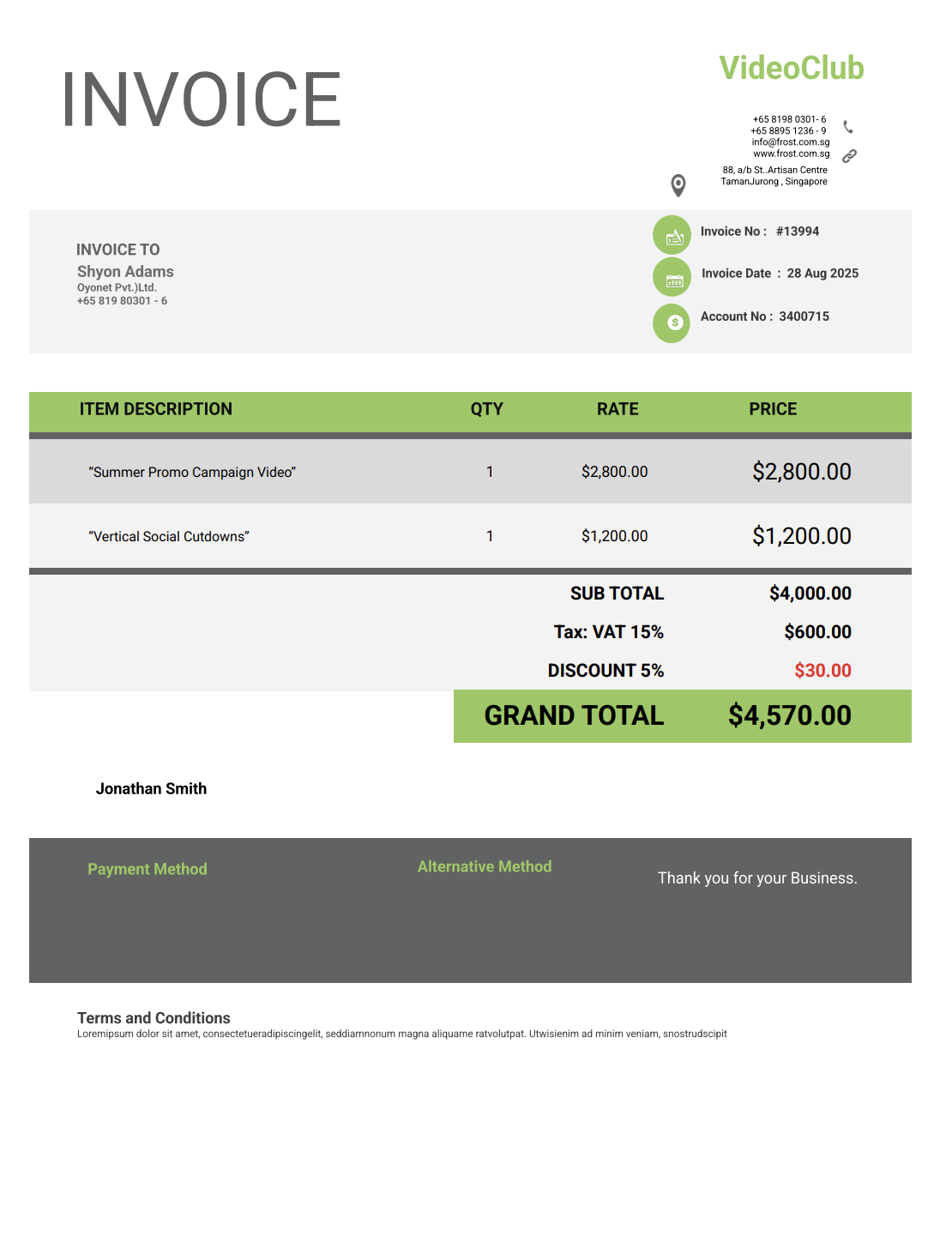
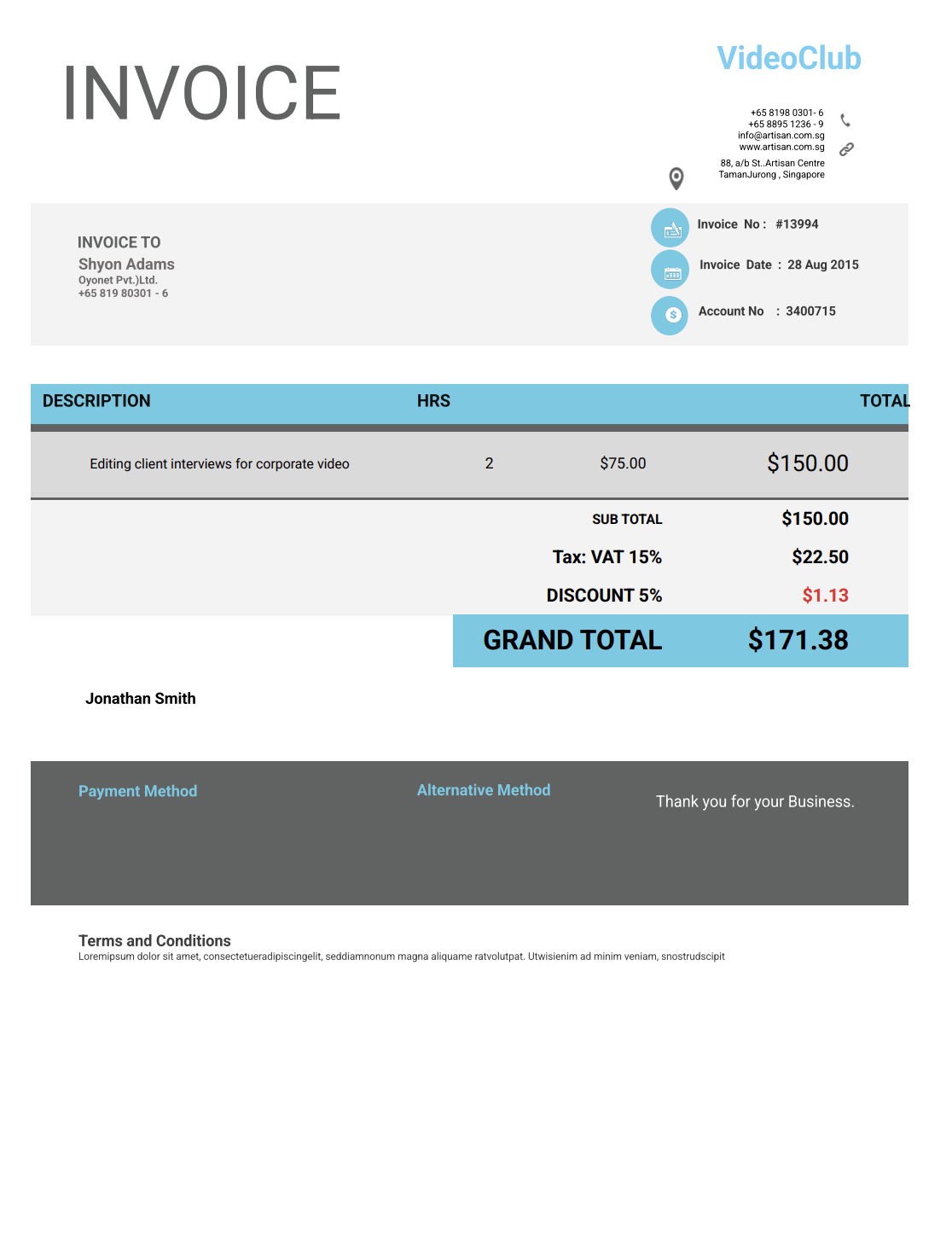
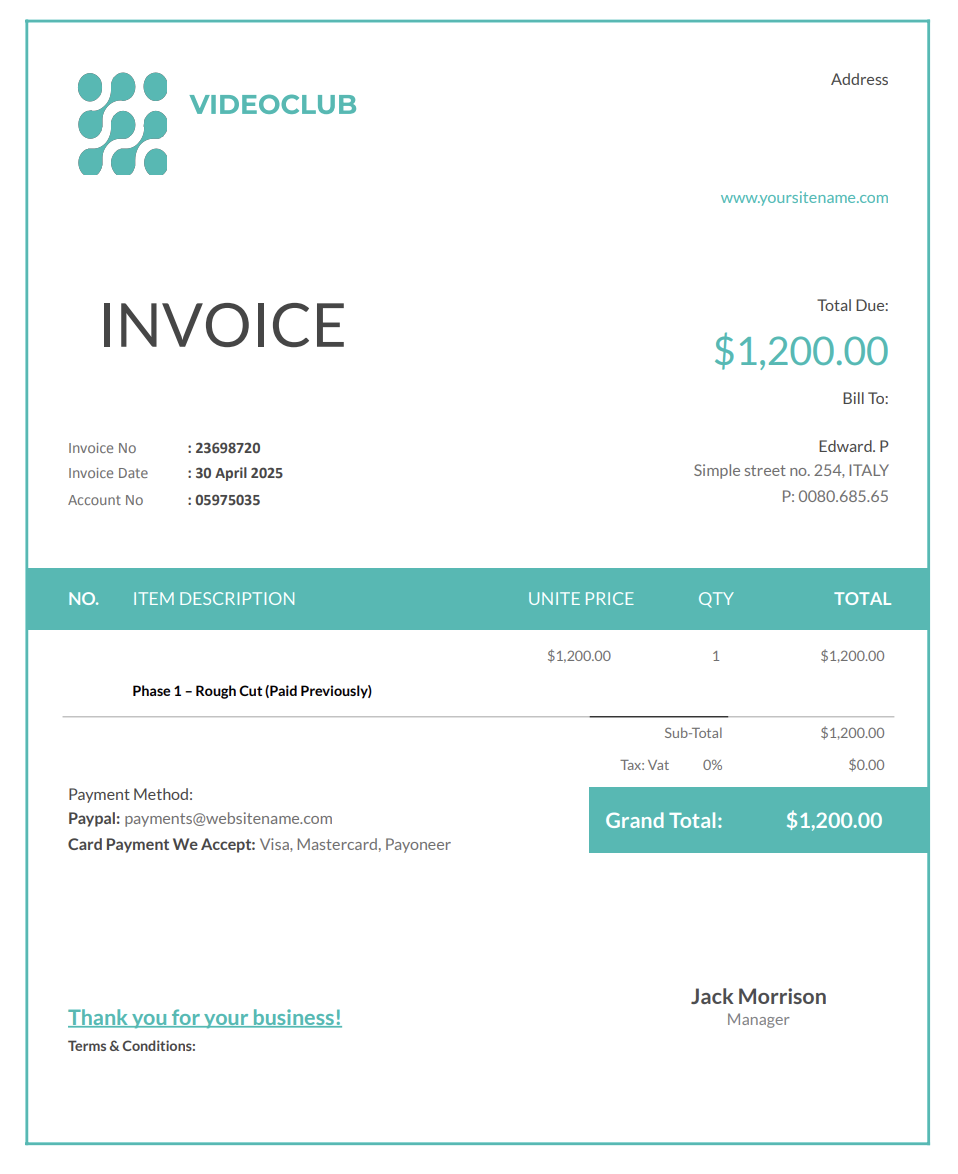
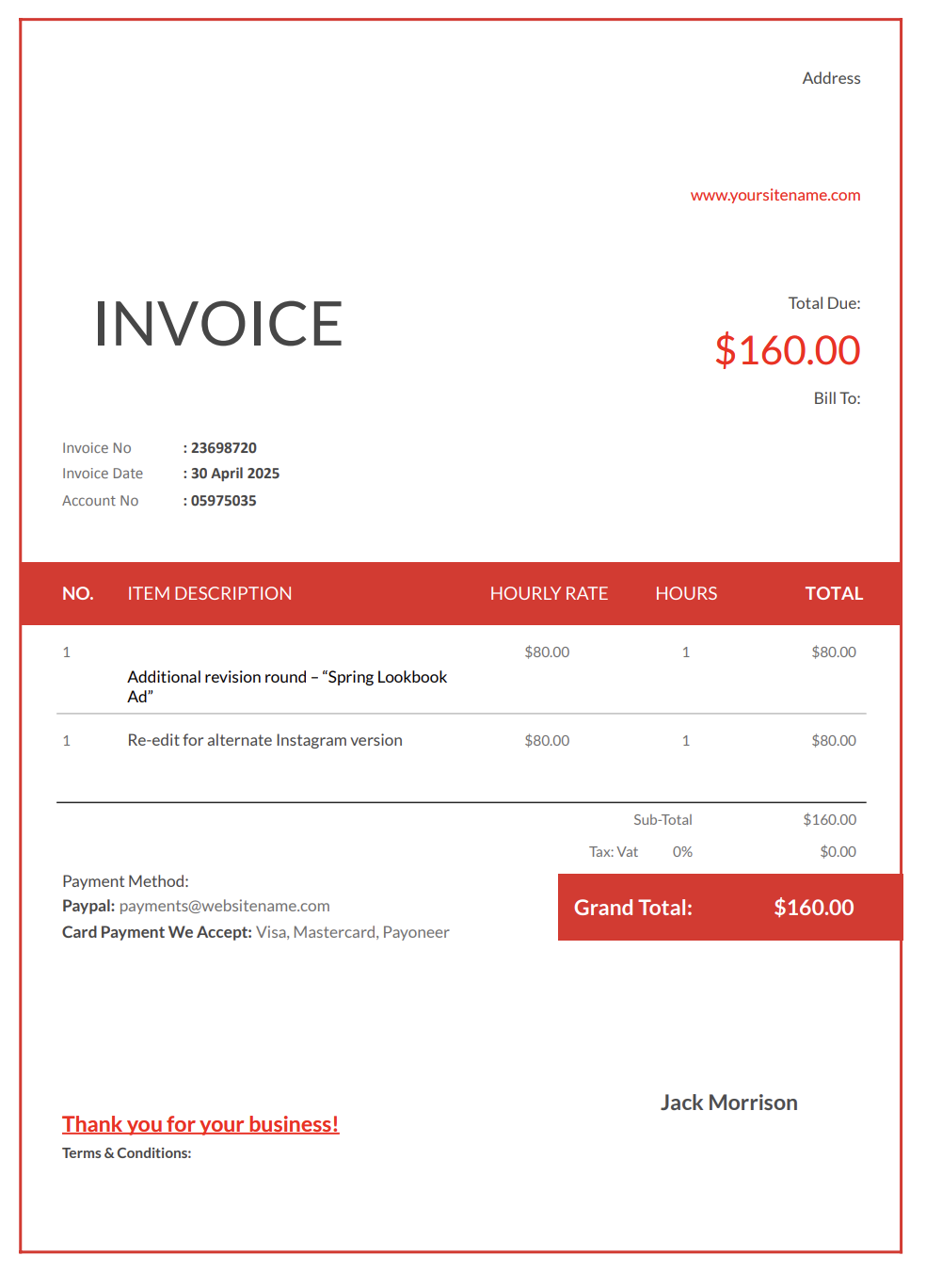
A video editor invoice template helps you bill clients quickly and professionally. It lists every deliverable, edit round, and deadline in one place so nothing gets lost between exports and feedback threads.
With Invoicer.ai, you can create video editor invoices in minutes, either by downloading free Word or Excel invoice templates or by customizing and sending invoices online directly through the software (which is much simpler).
Why Video Editors Need Professional Invoices
Here’s why professional invoices matter for editors:
- Faster payments: A detailed invoice speeds up client approvals and accounting.
- Project clarity: Lists timelines, versions, and deliverables so no one forgets what was included.
- Revision control: Lets you charge fairly for extra rounds or last-minute changes.
- Professional credibility: A branded invoice shows you treat editing as a serious business.
- Expense tracking: Helps log travel, software, or music-license costs for taxes.
- Protection: Acts as proof of what you delivered and when you’re owed payment.
- Client trust: Transparent pricing builds confidence and repeat work.
Different Types of Video Editing Invoices
No two edits are the same, so your billing shouldn’t be either. Here are the formats most editors use:
Per-Project Invoice
One flat price for a full video, ideal for fixed-scope jobs.
Hourly Invoice
Best for ongoing edits, revisions, or post-production assistance.
Milestone Invoice
Divide big projects into payment stages (rough cut, final cut, delivery).
Revision Invoice
For extra changes beyond the agreed edit rounds.
Retainer Invoice
For long-term clients who send you steady monthly footage.
Rush Job Invoice
When clients need same-day or weekend edits.
What to Include in a Video Editing Invoice
Your invoice should look as sharp as your timeline: organized, detailed, and easy to review. Include:
- Your details: Name, business name, website, and contact info.
- Client details: Company name, contact person, billing address.
- Invoice number & date: Keeps projects traceable.
- Project name: e.g., “Brand Commercial – Final Edit v2.”
- Services provided: Editing, color correction, sound design, motion graphics, and revisions.
- Rate structure: Hourly, per project, or milestone pricing.
- Due date & payment method: Set clear expectations.
- Expenses: Add-ons like music licenses, stock footage, or travel.
- Notes: Include delivery links, file format details, or license terms.
Music, Stock Footage, and Licensing Fees
Video projects often include third-party assets such as stock footage, stock music, voiceover, or templates. Your invoice should clarify whether these costs are included in your editing fee or billed separately as pass-through expenses.
Best practice:
- List third-party assets as separate line items when billed to the client.
- Attach receipts or license confirmations when appropriate.
- Keep the description neutral and specific (asset type + purpose).
Example line items:
- “Stock music license (receipt attached)”
- “Stock footage license (receipt attached).”
- “Motion graphics template license (as agreed).”
Deliverables, Export Formats, and Versions
Video editing invoices should always describe the final deliverables. This approach reduces back-and-forth and prevents clients from assuming that one edit includes unlimited versions, multiple aspect ratios, and every platform export.
Recommended deliverable details:
- Video type and length (for example, “60-second product video”)
- Number of deliverables included (main cut, teaser cut, variations)
- Export formats (MP4, MOV, ProRes, etc.) and resolution (1080p/4K)
- Aspect ratios included (16:9, 9:16, 1:1)
- Delivery method (download link, shared folder) and delivery date
Example line items:
- “Main edit: 60-second cut (16:9), 1080p MP4”
- “Vertical version: 9:16 export for Reels/TikTok”
- “Teaser cut: 15-second version (as agreed)”
Revisions, Additional Rounds, and Change Requests
Editing projects often expand through additional review cycles, new stakeholder feedback, or changes to the script and footage after the first cut.
Stating the revision scope on the invoice keeps expectations aligned and makes additional work easy to bill for.
Recommended approach:
- State how many revision rounds are included (for example, 1–2 rounds).
- Define what counts as a revision (timing, minor adjustments) versus a scope change (new direction, new sections, new footage, new concept).
- Bill extra rounds as separate line items once approved.
Suggested invoice note (optional):
“Includes up to [X] revision rounds. Additional revisions or expanded scope are billed separately when requested and approved.”
Example line items:
- “Additional revision round (approved on [Date]).”
- “Scope change: new sequence added (approved on [Date]).”
- “Additional edit time due to new footage received (approved on [Date]).
Raw Footage, Project Files, and File Handoff
Clients sometimes request raw footage, project files, or editable assets for future work. If you provide these, list them explicitly as separate deliverables. Project files and media organization often require additional time and storage.
Common handoff deliverables:
- Raw footage delivery (organized folder + naming conventions)
- Project files (Premiere/DaVinci/Final Cut) with linked assets
- After Effects project files for motion graphics
- Audio and music stems (where licensing permits)
Example line items:
- “Raw footage export and delivery (organized folders)”
- “Project file handoff (Premiere/DaVinci) – packaged and relinked”
- “Asset organization and handoff packaging (as agreed)."
Tips to Get Paid Quickly as a Video Editor
Deadlines are tight, feedback takes forever, and payments shouldn’t. Keep cash flow predictable with these habits:
- Use deposits: Collect 30–50% before importing the first clip.
- Invoice on milestones: Don’t wait until final delivery — bill at key stages.
- Offer digital payments: Include links for instant transfer.
- Send invoices with delivery links: Clients see the final cut and the bill in one go.
- Automate reminders: Let Invoicer.ai nudge clients politely.
- Itemize revisions: Make clear which ones are included and which cost extra.
- Keep archives: Save every invoice and contract in case you need proof later.
Efficient billing means you spend less time chasing money and more time chasing creative perfection.
Rush Fees and Expedited Turnaround
Editing often supports launches and campaigns with fixed deadlines. If you deliver on an expedited timeline, it's reasonable to invoice a rush fee.
How to bill rush work:
- Add it as a separate line item (“Rush fee” or “Expedited delivery”).
- Reference the turnaround time (for example, “24–48 hour turnaround”).
- Apply it consistently to avoid negotiation on every project.
Example line items:
- “Rush fee (24–48 hour turnaround).”
- “Same-day revisions (as agreed).”
Storage, File Transfer, and Long-Term Hosting
Video editing often involves large file delivery and storage. If your workflow includes paid cloud storage, long-term hosting, or courier drives, listing these costs separately keeps the invoice transparent.
Common billable items (when applicable):
- Cloud storage and transfer fees (large delivery links, extended hosting)
- Archive storage beyond an agreed period
- Physical drive delivery (SSD/HDD) and shipping
Example line items:
- “Cloud transfer and hosting (30 days)”
- “Project archive storage (90 days)”
- “SSD delivery + shipping (as agreed).”
When and How to Send Video Editing Invoices
Editing cycles vary, but consistent billing keeps projects on schedule:
- Per-project: Invoice after final delivery or split into 50/50 deposit and completion.
- Milestones: Send at each stage — rough cut, color grade, sound mix, final render.
- Retainers: Bill monthly on the same date for recurring clients.
- Hourly edits: Invoice weekly or bi-weekly with time logs attached.
- Rush work: Bill immediately after completion to reinforce urgency.
- Revisions: Send separate invoices for additional rounds after sign-off.
With Invoicer.ai, invoices are emailed instantly, tracked when opened, and followed by automatic late payment reminders.
Simple Tweaks to Make Your Video Editing Invoice Stand Out
Clients judge presentation, even on paperwork. Make your invoice as visually confident as your reel.
- Add your studio branding: Consistent fonts and logo reinforce professionalism.
- Use neutral colors: Grey, black, or muted blue — crisp and cinematic.
- Label version & delivery date: Example: “Invoice for Final Cut – May 2025.”
- Highlight deadlines and fees: Easy to read, no confusion.
- Link directly to your portfolio: Reminds clients why you’re worth every cent.
- Add a short note: “Thanks for trusting me with your footage.” keeps it personal.
Why Choose Invoicer.ai Over Word, Excel, or QuickBooks
Spreadsheets aren’t built for storytelling. Word templates break formatting, and QuickBooks feels like overkill when you just want to track edits and payments.
Invoicer.ai gives editors exactly what they need:
- Pre-built video editor invoice templates (Word, Excel, PDF).
- Create, customize, and send invoices online in minutes.
- Add per-hour, per-project, or milestone billing.
- Attach project links or delivery notes.
- Automate payment tracking and reminders.
- Save recurring templates for loyal clients.
- Clean, cinematic layouts that reflect your craft.
- Recurring invoices. Availible on Advanced plan.
It’s the simplest post-production tool you didn’t know you needed.
Get Paid the Easy Way
A video editor invoice template brings structure to your creative business. Instead of juggling messy PDFs or forgotten payments, you’ll have a professional system that keeps your projects profitable and organized.
Once the invoice is ready, you can schedule it to send when it makes the most sense for the job or your billing routine.
Start your free 14-day trial today and let Invoicer.ai handle the billing — so you can stay focused on the edit, not the paperwork.