

Choose a template below and:
1. Select Make a Free Copy. Sign in to Google if asked.
2. Google Sheets saves your own copy to your Drive, ready to edit.
Replace the sample details with yours. Line totals, tax, and the estimate total calculate automatically.
Everyday Google Sheets estimate templates for quoting any job. Open a copy in your Drive and start editing right away.

Clean estimate with a red header, itemized pricing, and a payment information block.

Light green layout with customer ID, payment terms, and a bill to block.

Formal blue gray design with a company slogan, discount line, and signature block.
Skip the template. Create, send, and track estimates with Invoicer.
Create Your EstimateGoogle Sheets estimate templates for service work and projects, with labor, materials, discounts, and payment details.

Service-based estimate with a PO number field and room for a detailed description on each line.
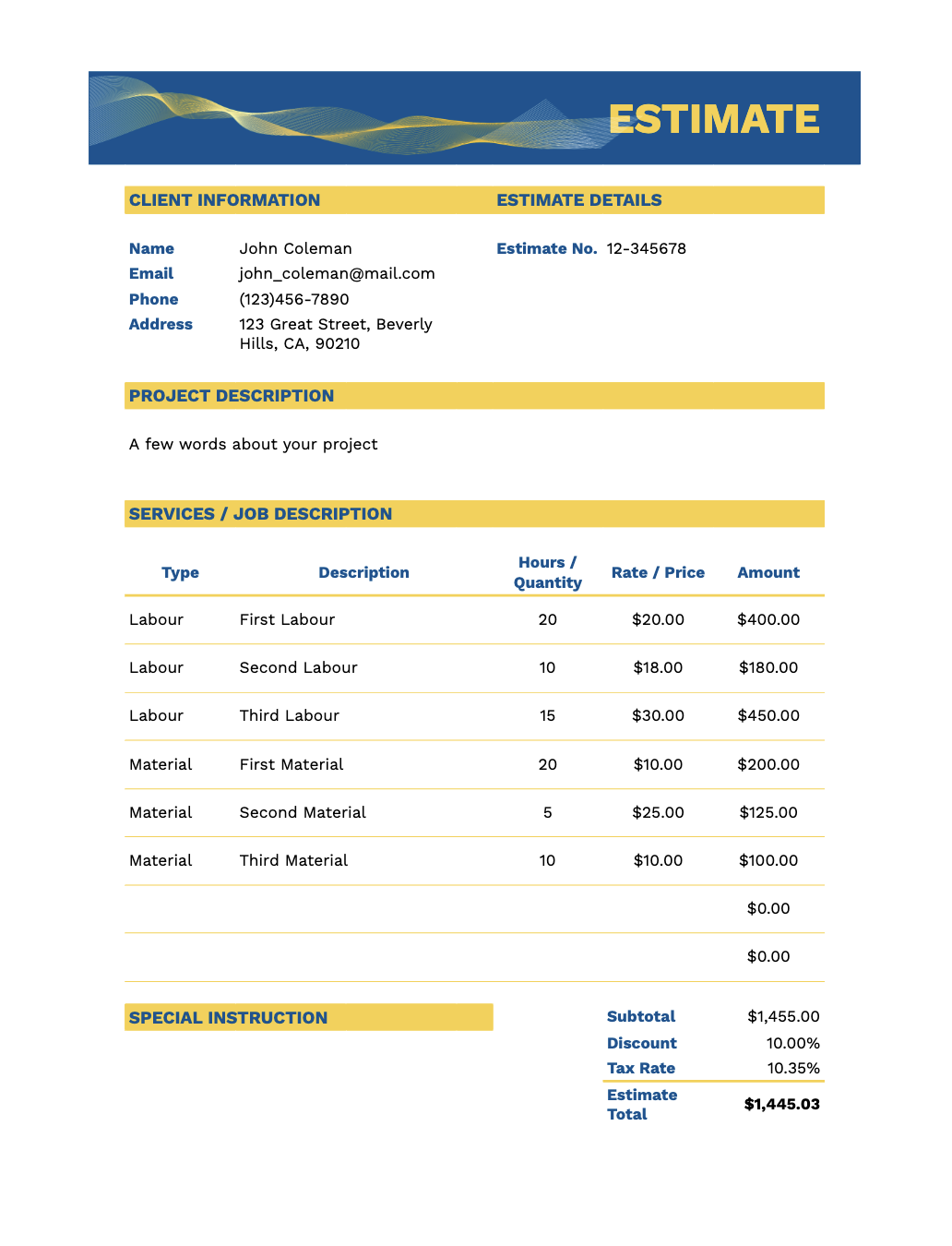
Splits labor and materials by line, with a project description and special instructions.

Business estimate with estimate to and from blocks, payment method, and terms.
Skip the template. Create, send, and track estimates with Invoicer.
Create Your EstimateGoogle Sheets estimate templates built for specific trades. Enter quantities and rates, and the subtotal, tax, and total calculate automatically.
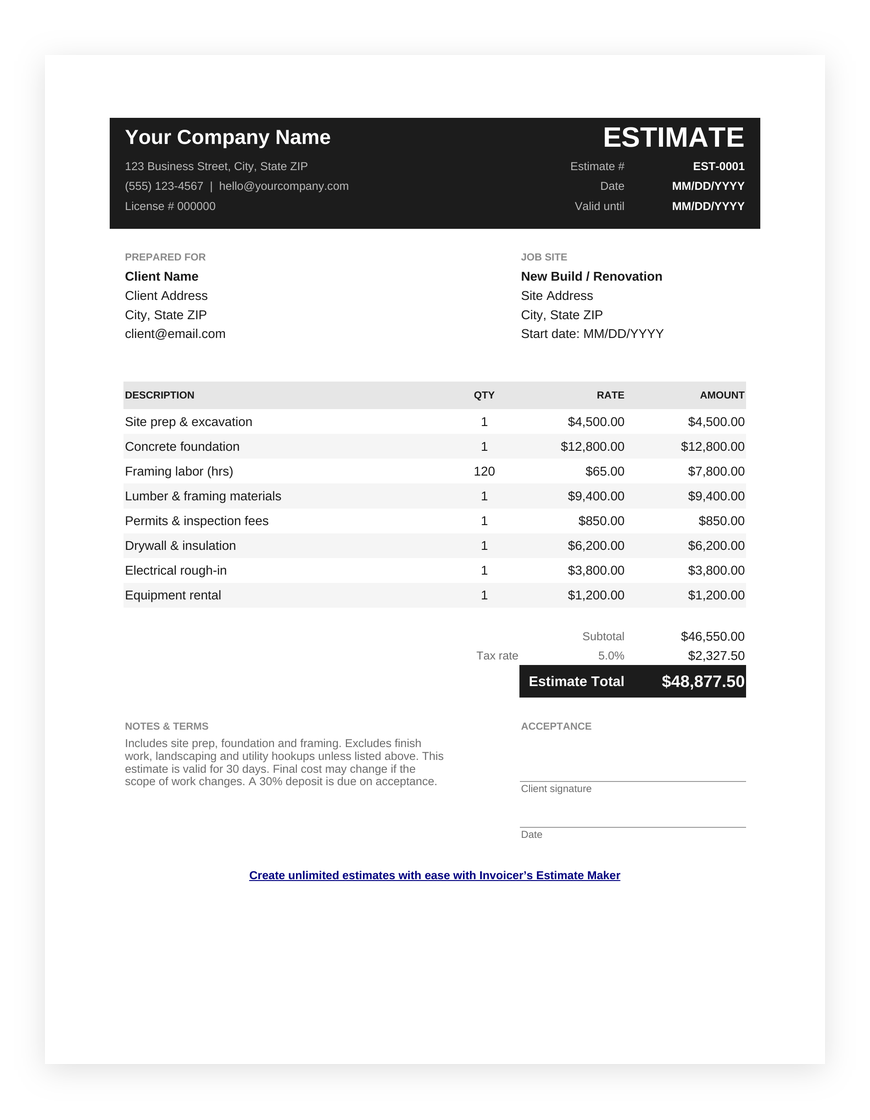
Bold black header with a full cost breakdown for site prep, foundation, framing, and permits.
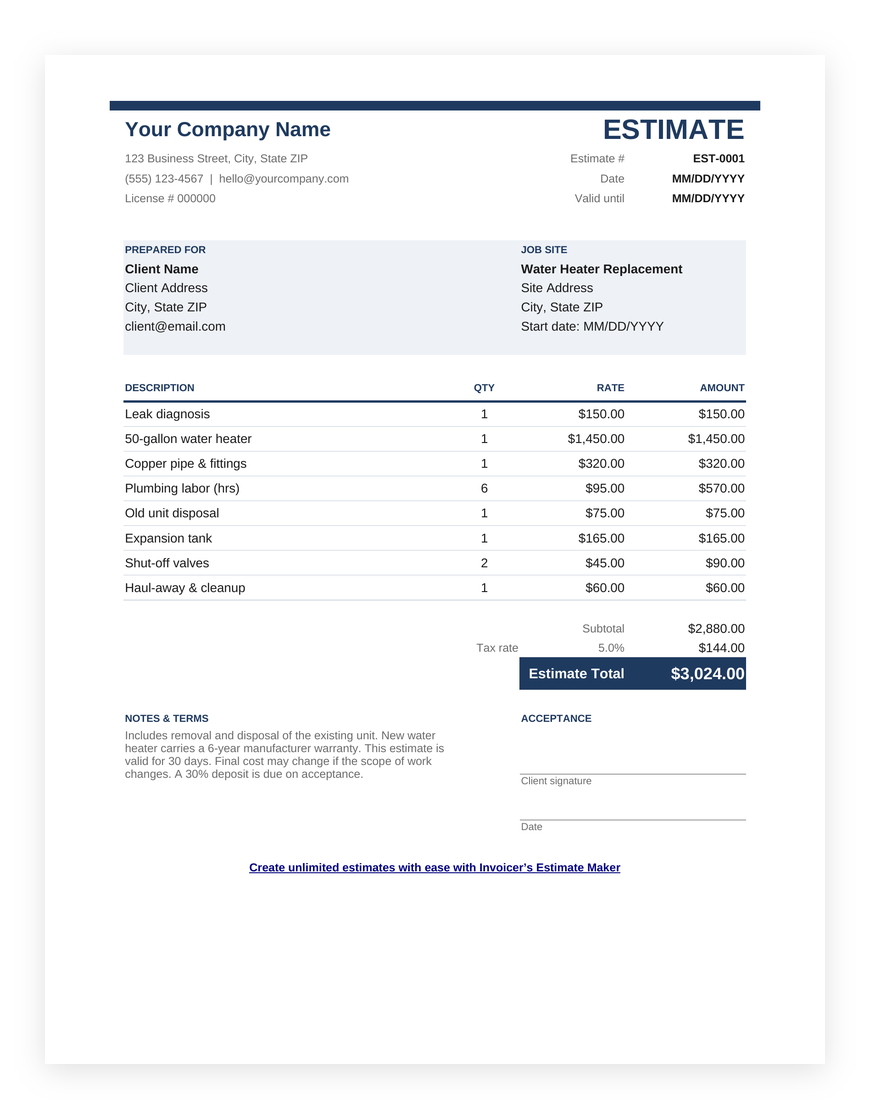
Navy-accented estimate for water heater swaps, repairs, and installs, with parts and labor itemized.
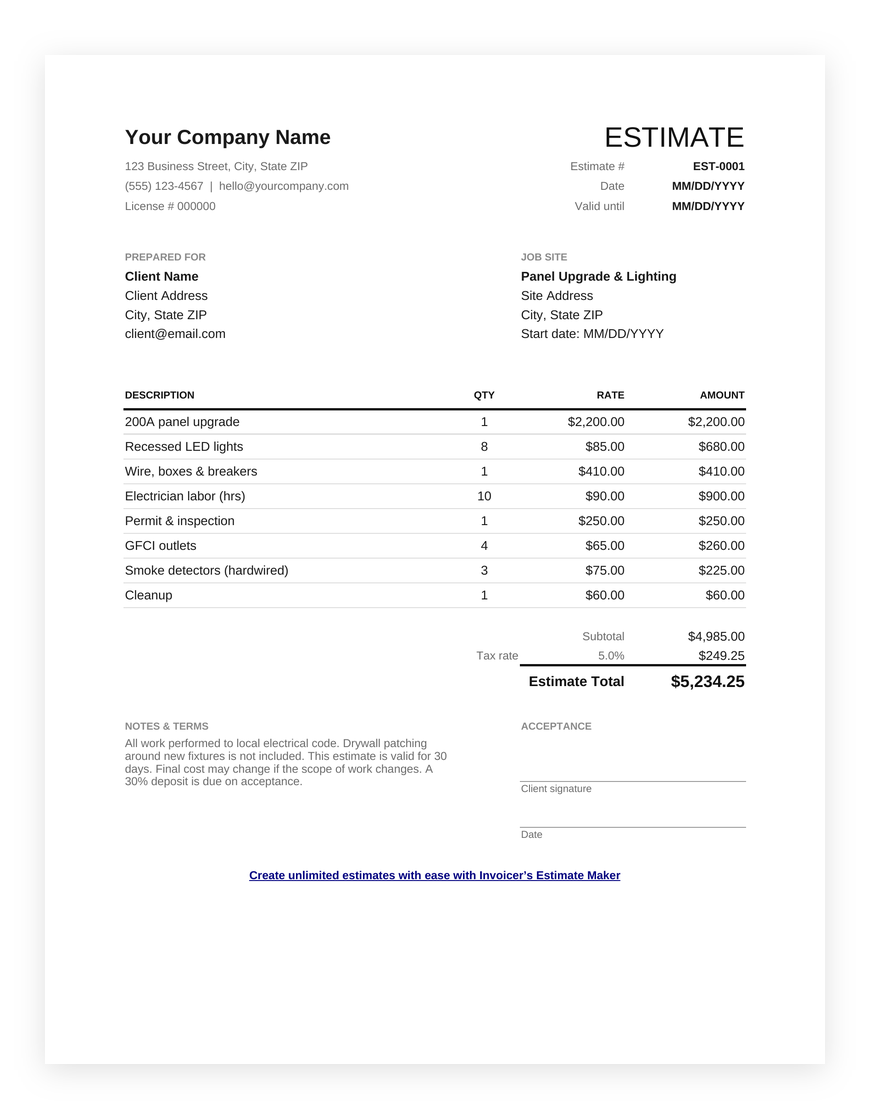
Minimal black-and-white layout for panel upgrades, lighting, and wiring jobs.
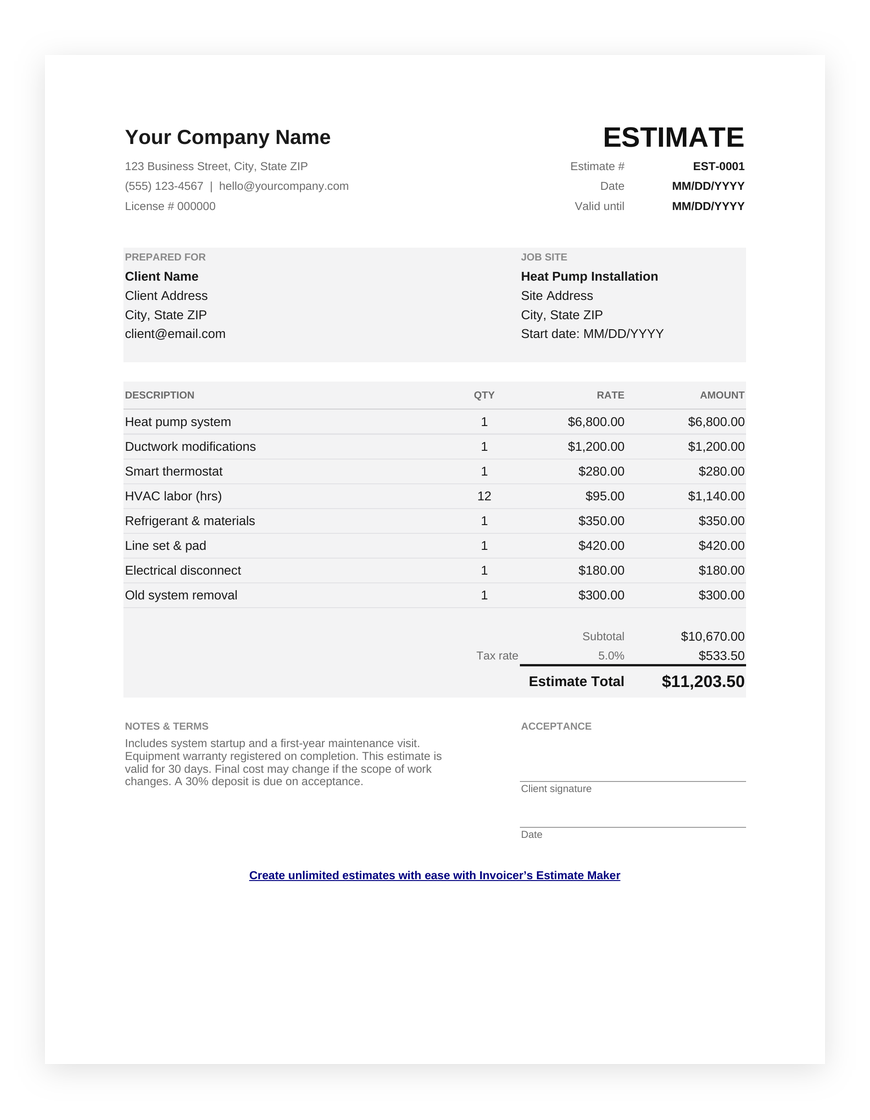
Card-style layout for heat pump and furnace installs, with equipment and labor split out.
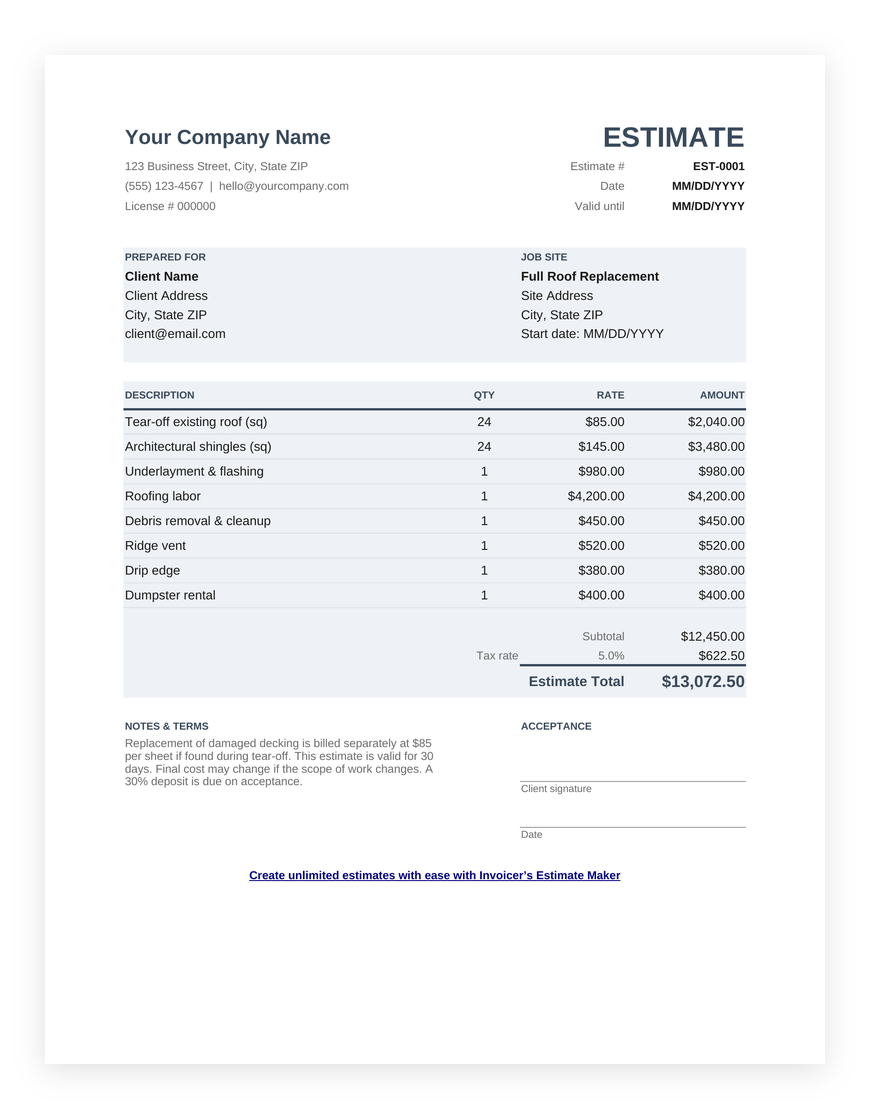
Card-style layout with a slate-blue accent for tear-offs, re-roofs, and repairs.
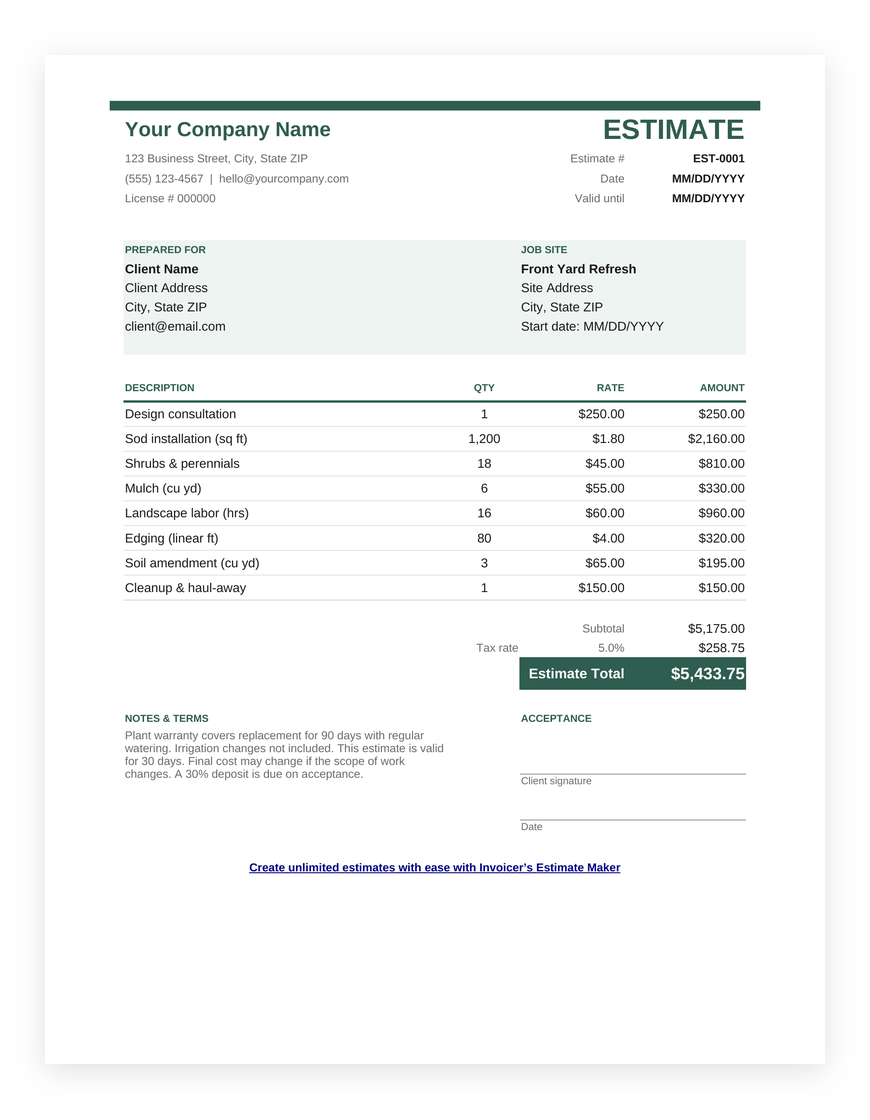
Forest-green estimate for landscape installs, sod, planting, and cleanup.
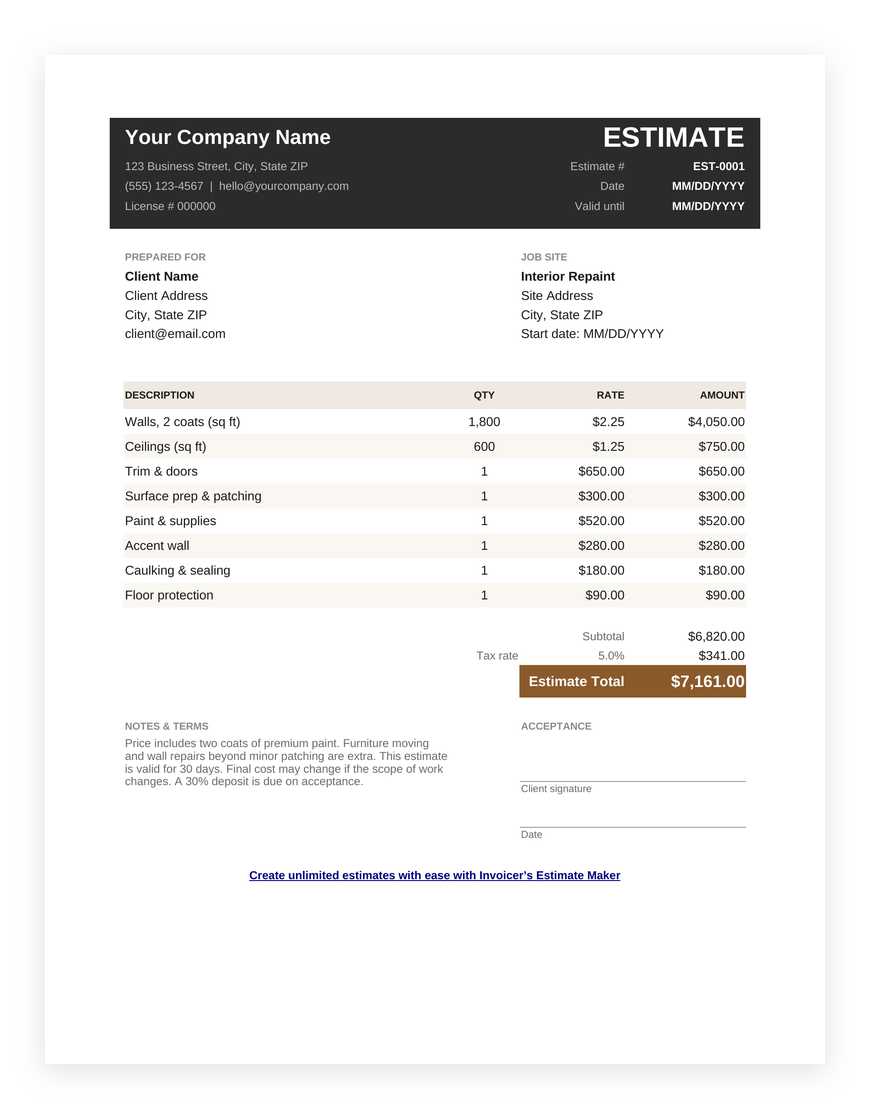
Charcoal header with a warm accent, priced by the square foot for walls, ceilings, and trim.
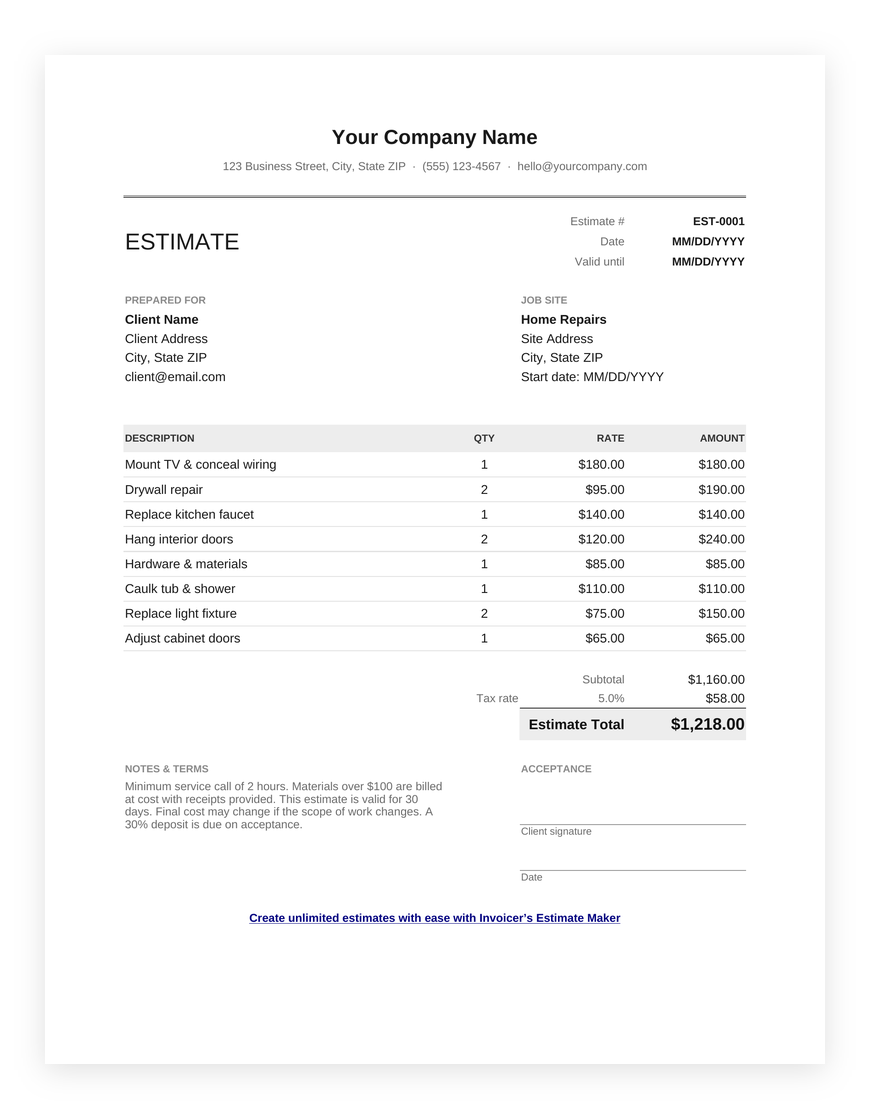
Classic centered letterhead in greys, built for small repairs and odd jobs.
Skip the template. Create, send, and track estimates with Invoicer.
Create Your Estimate
Easy and intuitive estimate maker.

Clear and simple process for your clients to approve.

Easily customize with your brand and colors.
Here is everything you need to know about Google Sheets estimate templates. Who they are for, how they work, what to put in them, and pros and cons of a Google Sheets estimate template.
A Google Sheets estimate template is a structured spreadsheet that helps businesses create estimates with automated calculations. It’s a cloud-based alternative to Excel, allowing for real-time collaboration while still offering built-in formulas to track pricing, taxes, and totals.
Starting from a template is usually faster than building your own spreadsheet because the basic layout and calculations are already in place.
A Google Sheets estimate template uses a pre-formatted spreadsheet with sections for client information, services, materials, labor, taxes, discounts, and estimated costs. Built-in formulas automatically calculate totals as you enter or update the information.
Because the estimate is stored in Google Sheets, you can access it from different devices, collaborate with team members in real time, share it with clients, or export the finished estimate as a PDF.
Use separate sections for your business information, client details, project description, and cost breakdown. Tables can help keep descriptions, quantities, rates, and totals aligned and easy to read.
Customize the template by adding your logo, brand colors, preferred fonts, and contact details. You can also rename sections, add or remove fields, and adjust the layout depending on the type of work you provide.
Before sending the estimate, review it in print or PDF view to make sure the formatting is consistent and that tables, totals, and text appear correctly.
There are three main ways to create a Google Sheets estimate template: building a custom sheet from scratch (Time-consuming), using a premade template (Faster), or using an estimate generator (Fastest and most efficient).
A Google Sheets estimate template simplifies cost estimation by automating calculations while allowing teams to edit and review estimates in real-time. If you need a collaborative, cloud-based solution for estimating, Google Sheets is a great choice.
Start by opening the template in Google Sheets and making your own copy. Then, add your business and client information, then enter the services, materials, quantities, rates, taxes, and discounts that apply to the job.
Check that the formulas calculate the subtotal and estimated total correctly, then customize the colors or add your logo if needed.
Once the estimate is complete, you can share the Google Sheets file with your client or download it as a PDF before sending it.
To keep the estimate organized, use separate columns for descriptions, unit prices, quantities, and totals. Apply bold headers, gridlines, and color-coding to make it easier to read. You can also use conditional formatting to highlight missing information, expired estimates, or unusually high costs.
A Google Sheets estimate template can be customized to match your business and the type of work you provide. Start by adding your company name, logo, contact details, and preferred colors. You can also rename columns, add or remove fields, and adjust the layout to include the information your clients need.
Update the formulas if you need to calculate taxes, discounts, labor, materials, or other costs automatically. You can also change fonts, borders, and number formats to make the estimate easier to read and more consistent with your branding.
Before sending the estimate, check that all formulas are working correctly and that the final total updates when quantities or prices change.
Google Sheets estimate templates work well for simple estimates, but they can become less practical as your workload grows. If you create estimates frequently, manage many clients, or need to track approvals and estimate statuses, handling everything manually in separate spreadsheets can take extra time.
Google Sheets and Excel both work well for creating estimates with formulas and automatic calculations. Google Sheets is particularly useful when you need cloud access, easy sharing, or real-time collaboration. Excel can be a better choice when you prefer working offline or need more advanced spreadsheet features.
If you prefer Microsoft Excel, you can also use our free Excel estimate templates.
This template is best for:
Google Sheets estimate templates are a great starting point. However, for a quicker and more automated solution, the Estimate Maker from Invoicer.ai provides built-in calculations, easy adjustments, professional estimates, and time-saving templates. Plus, you can try it free for 14 days!

